

Adam Henig is the author of four books, including his most recent, “Baseball’s Outcast: The Story of Ron LeFlore.” This piece was produced in partnership with Viva La Book Review.
Growing up in the San Francisco Bay Area in the 1990s, I associated UC Berkeley with “the naked guy”; professors who never saw the inside of a classroom, only a research lab; Tightwad Hill (above the stadium where the Golden Bears play); and its longtime nickname, Berserkeley.
When I visited the campus and inevitably encountered such landmarks as Sproul Plaza, Sather Gate and the Clark Kerr residence halls, these sites had little meaning to me.
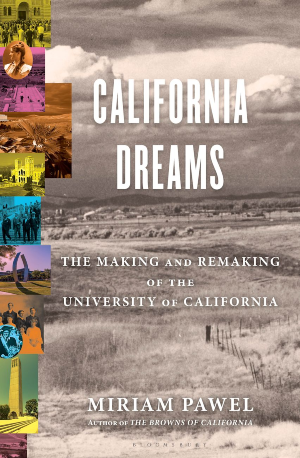
Now “California Dreams: The Making and Remaking of the University of California” (Bloomsbury, 2026), an absorbing new book by historian Miriam Pawel, has filled in those gaps and more.

It’s Golden State’s first birthday!
If you enjoy what you’re reading, please consider giving a gift to support a second year of independent, homegrown journalism.
Pawel — a Pulitzer Prize-winning journalist and a biographer of Cesar Chavez and the Brown political dynasty (i.e., Edmund G. “Pat” Brown and Jerry Brown) — documents the rise of one of the nation’s most influential and successful public university systems. Her account helps to explain the symbiosis between UC and California, and how we arrived at the major crises afflicting today’s college campuses: obstructive political activism, out-of-touch faculty, the emphasis on donors, overcrowded classrooms, shrinking college acceptance rates and tuition that increases with each passing year.
Pawel chronicles the 160-year evolution of California’s most revered institution through the actions of a sweeping cast of characters, but especially five individuals whose lives, she writes, were transformed by the university. Beginning with one of the earliest graduating classes at Berkeley — the system’s first campus and the only one earning the distinction of being called “Cal” (none of the other 10 UCs can claim it) — Pawel shares the story of Milicent Shin.
Born in 1858 and raised on a farm in nearby Niles (now Fremont), Shin was fortunate to have come of age during the construction of UC’s first two buildings north of Oakland, in the newly founded hamlet of Berkeley. Despite being one of the few women on campus, she stayed the course and plowed through her studies while not having to worry about paying for tuition — there was none. As Pawel points out, this is what separated UC from existing private institutions like Harvard and Princeton — it was open to women and tuition was free. Shin eventually became a successful magazine editor, author, pioneering scholar of child psychology and an activist in the women’s suffrage movement.
By the 1920s, with Cal well established, grumblings in the southern part of the state made their way north. SoCal residents wanted their own university. A location was finally identified, between downtown Los Angeles and the coast, the last of the region’s open space. Westwood, and UCLA, was established and so was the UC system we know today.
Through the Great Depression and World War II, the Golden State continued to grow at an incredible rate. With the help of the GI Bill, demand for higher education was greater than ever before. With ample public support, UC expanded with two additional campuses, Santa Barbara and Riverside.
 Mariel Garza
When California surpassed New York as the nation’s most populated state, the number of slots available for students was not enough. To accommodate California’s rapid growth, Pawel explained, another college system was proposed, one with lower qualifications that would not be in direct competition with UC. After much debate in Sacramento, the 1960 “master plan” was hatched and a three-tier public higher education system was codified: the University of California, the California State University (originally four-year state colleges; now 22 Cal State universities), and the California Community Colleges, two-year “junior colleges” designed to be a transfer portal to UC or CSU.
Among all the UC characters featured in “California Dreams,” the most notable is Clark Kerr, a Berkeley economics professor who became chancellor at Cal and ultimately president of UC, presiding over the master plan and the university’s continued expansion: Davis, San Diego, San Francisco, Irvine and Santa Cruz. He was the consummate academic who also attempted (and in some cases, failed) to rise above the political headwinds to protect and preserve the prized institution.
Although Kerr did not depart UC as he’d envisioned — he was fired with the help of newly elected Gov. Ronald Reagan over his handling of campus political activism (sounds familiar?) — no single individual was more responsible for the University of California’s future successes.

Golden State is a reader-supported publication. Help us stay independent by upgrading to a paid subscription.
After removing Kerr from his post, one of Reagan’s first acts was to cut UC’s funding, resulting in constant tuition hikes to offset state subsidies. With the passage of Proposition 13, which capped California property taxes, state funding diminished even more, to the point where UC considered closing its less prestigious campuses (Riverside and Santa Cruz) to bridge the gap. Yet the institution, led by its dedicated and distinguished alumni, many of whom became the leaders of the system, fought to ensure that UC stayed true to its original mission: providing high quality education and making it accessible to everyone, including first generation college students and those from historically underrepresented groups.
From its agrarian and gold-mining roots to its rank as the world’s fourth largest economy, California without UC, according to Pawel, would not be what it is today — the hub of almost every industry: science and technology, agriculture, entertainment, defense and, of course, higher education. The author delivers a masterfully synthesized work of history, combining a compelling narrative with fascinating insights in this must-read book.
What do you think? Golden State is a public forum. Send your responses for possible publication to forum@golden-state.org.

