

Maylin Tu is a freelance writer and reporter covering transportation, homelessness and infrastructure in Los Angeles who has written for the Guardian, PBS SoCal, LAist, LA Public Press and other outlets.
During the mayoral primary, Republican influencer Spencer Pratt used Skid Row as a target to pummel the leadership of Mayor Karen Bass. And in the runoff, Bass and Councilmember Nithya Raman have both said they will significantly reduce homelessness in Los Angeles.
But what that means for Skid Row isn’t clear.
After a joint federal-local raid last month targeting suspected drug dealers in the area, I reached out to the Bass and Raman campaigns to ask about their visions for Skid Row.

Support our election coverage. Golden State's reporting and analysis is free to read, but not to produce. You can help us by making a tax-deductible gift. It's the smartest donation you can make this election cycle.
Neither provided a statement or answered specific questions. Instead, I listened to their comments in news conferences and public forums to try to understand their plans. Astonishingly, neither candidate appears to have an independent, coherent vision for Skid Row and a plan to execute it.
And as the saying goes, nature abhors a vacuum. Enter the Trump administration, which seems to have a clear vision.
On Oct. 8, armed federal agents swarmed Skid Row near 5th and Crocker streets, searching tents and handcuffing suspected drug dealers. It was part of a new, ongoing effort dubbed "Operation Save Skid Row," led by the U.S. Department of Justice and its top prosecutor in Los Angeles, Bill Essayli, with collaboration from the Los Angeles Police Department and multiple federal agencies. Bass and other officials said at a news conference following the raid that their goal is to protect Skid Row from violent, predatory criminals who keep people addicted in order to exploit them.
"This is the beginning of what we're going to do to attack the problem," said L.A. County District Attorney Nathan Hochman at the news conference. "And when we're done, we hope there is no definition of Los Angeles that includes the words 'Skid Row.'"
 Sam Quinones
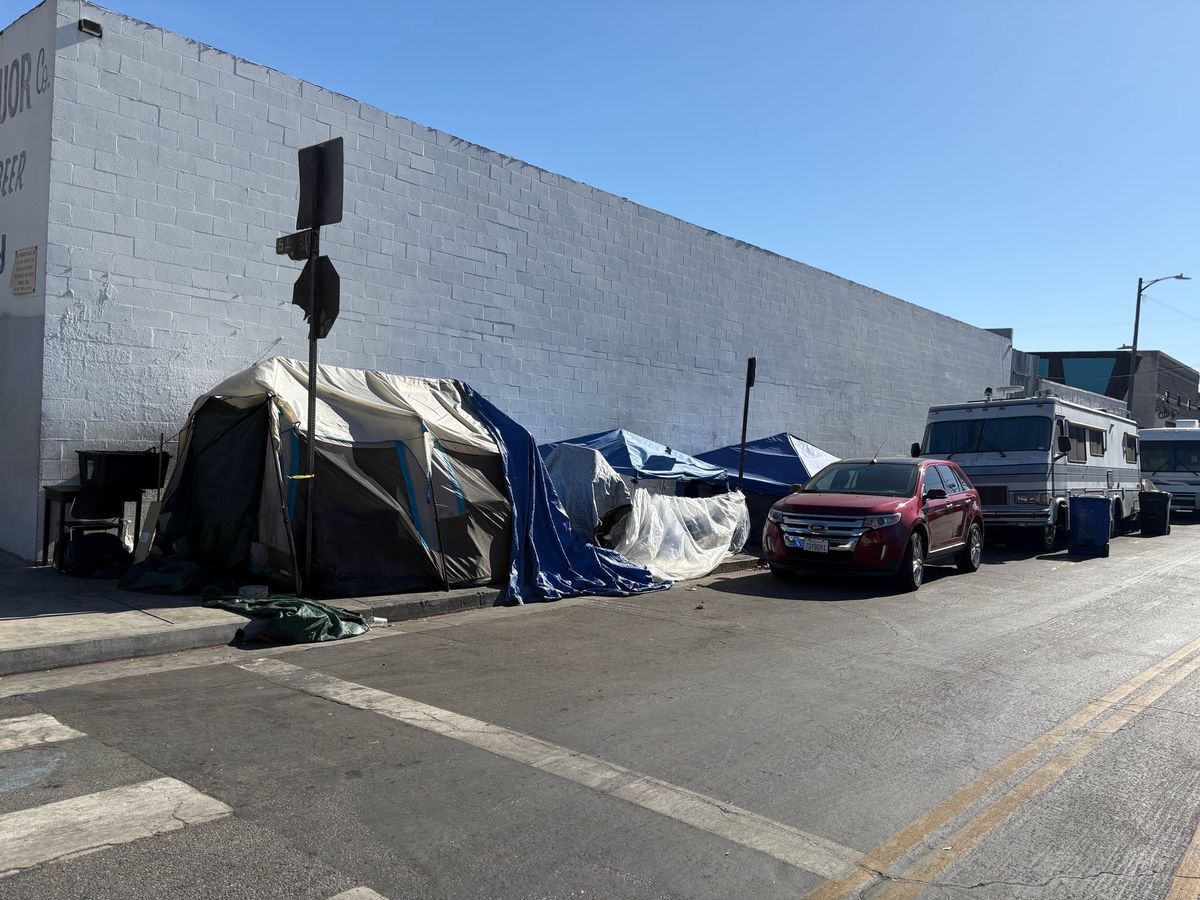
Less advertised was that 5th and Crocker is also the site of the Skid Row Care Campus, a facility opened last year by L.A. County providing showers, bathrooms, laundry and, controversially, access to harm-reduction supplies like clean needles and pipes. The raid resulted in the temporary closure of the Care Campus and shut down surrounding streets.
The distribution of these items is meant to prevent HIV and other infections in people who use drugs while also connecting them to future options for treatment. The campus has paused the distribution of syringes and pipes, according to a spokesperson for L.A. County’s Department of Health Services.
The Care Campus, which has faced backlash from neighbors and business interests amid reports of rising crime rates, opened after a years-long effort by the county to find a way to serve the health and wellbeing of Skid Row residents, especially drug users, sex workers and unhoused people.
 Dan Morain
Some Skid Row residents speculated the location of the crackdown was meant as a message from the Trump administration about the Care Campus and its harm-reduction services.
That message would eventually come loud and clear – but from Bass. "I did not support the Care Campus when it was being built," she said at an Oct. 15 mayoral forum hosted by the Downtown Los Angeles Residents Association. "To me, it was obvious what was going to happen down there."
In fact, support for harm-reduction strategies is one area where Bass and Raman seem to have a clear difference.
 Golden State staff
This isn't the first time in the campaign that Bass has broken with the city's support of needle exchange services, which goes back to then-Mayor Richard Riordan’s declaration of a state of emergency over HIV transmission in 1994. After another raid in MacArthur Park in May – also a joint operation with the feds – Bass said she opposed the distribution of clean needles.
Despite Bass' public skepticism, the county continues to support harm-reduction strategies such as needle exchange. And it's for a good reason: Simply put, they work.
"People who engage in harm-reduction services are three times more likely to actually reduce or stop using drugs, and five times more likely to participate in substance use treatment," Brian Hurley, interim director of the Bureau of Substance Abuse Prevention and Control for the L.A. County Department of Public Health, said in an interview.
 Golden State staff

Raman appears to agree, suggesting the county's harm-reduction efforts on Skid Row are more likely to find an ally in Bass' opponent. "Needle exchanges save lives," she said in response to a question at the Oct. 15 forum about publicly funded distribution of drug supplies like clean needles and pipes. She added that she supports it in conjunction with other treatment programs.
Both candidates said they would continue supporting Operation Save Skid Row, although Raman added that she would not coordinate with U.S. Immigration and Customs Enforcement.
Of course, a comprehensive vision for Skid Row cannot be boiled down to the candidates' stances on drug enforcement. But Bass' praise for the federal raid and rejection of harm-reduction efforts seem to put her more in line with the Trump administration and its LAPD collaborators than the service providers who have worked in Skid Row for years.
Whichever candidate wins, she should get to work on an actual plan for Skid Row – because the Trump administration seems all too eager to provide one for the city.
What do you think? Golden State Report is a public forum. Send your responses for possible publication to forum@golden-state.org.


