

Adam Henig is the author of four books, including his most recent, “Baseball’s Outcast: The Story of Ron LeFlore.”
Los Angeles and Nazis? It’s not an association we often make with the City of Angels, but Michael Benson’s fast-paced nonfiction thriller, “Hollywood vs. Nazis: How the Movie Studios Took On Nazis Infiltrating Los Angeles,” will make Angelenos rethink that relationship.
Packed with drama, violence and espionage, Benson shares in vivid detail the story of Leon Lewis, a Jewish lawyer with a long track record of fighting antisemitism. In 1933 Lewis formed the Los Angeles Jewish Community Committee, which Benson refers to as the “Nazibusters.” It’s a fascinating tale, and Benson tells it compellingly – problem is, he acknowledges embellishing in places to improve the narrative flow of a book marketed as nonfiction. Are readers learning actual history or being entertained?
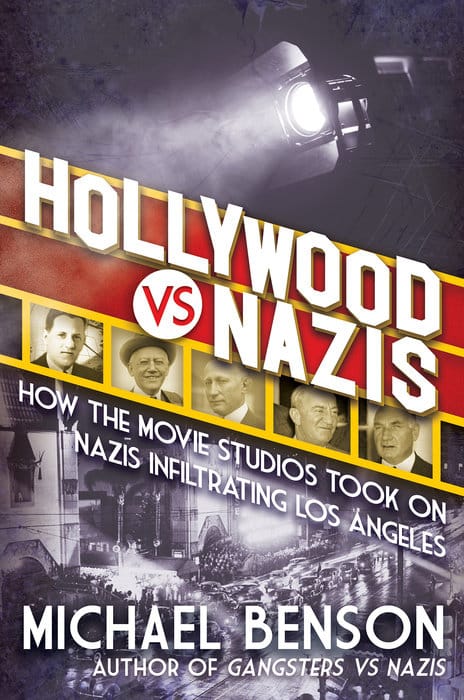
According to the author, after seizing control of Germany in 1933, Hitler and the Nazis recognized the United States as the greatest threat to their ambition of global dominance. They were convinced that if they could get Hollywood’s movie studios to distribute films sympathetic to their cause, Americans may be less inclined to help their traditional allies in Europe if a war broke out.
Initially, the Nazis formed an innocuous-sounding heritage organization and reached out to German Americans in Tinseltown. Lewis saw right through it and was determined to stop it before it would be too late.

Golden State is a member-supported publication. No billionaires tell us what to do. If you enjoy what you're reading, please consider upgrading to a paid subscription and support independent, home-grown journalism.
Convinced that the local authorities were either apathetic or, in some cases, sympathetic to the Nazis (“there was a big overlap between the ranks of the LAPD and KKK,” Benson points out), Lewis took matters into his own hands.
Lewis recruited residents he knew with little or no military or law enforcement experience – most of whom were not even Jewish – to serve as spies and report their findings to the committee. These Angelenos were trained in disguise and other espionage tactics, and it worked: They infiltrated Nazi meetings and social gatherings and produced valuable intelligence on everything from the group’s facilities to its recruitment tactics. This information would go on to serve as the basis of federal investigations of Nazis in L.A., as Benson tells it.
After unsuccessfully taking the organization to court – Lewis couldn’t prove that the führer’s followers were using a legitimate German American organization to advance their nefarious ideas and schemes – the indefatigable lawyer needed more funding to continue his operation. He turned to "rich Jewish bankers and businessmen that had promised" to help, but they did not follow through. Lewis then turned to those who were in charge of the motion picture industry. The Warner brothers, Louis B. Mayer and a host of other Hollywood elites – most of whom were Jewish – joined Lewis’ crusade, which ultimately derailed the Nazis’ efforts.
The author of 40-plus books, many in the true-crime genre, Benson acknowledged in his author’s note that he altered components of the story in order to develop a "smooth narrative flow." He "supplemented" dialogue, adjusted the chronology of events, and created "composite" characters (meaning he blended two or more real people into one character).
 Mariel Garza
These are common practices in storytelling. Filmmakers Oliver Stone and Steven Spielberg have done this in movies “based on a true story,” not least because movies have to fit within a 120- minute run time. Historical novelists – James Michener, T.C. Boyle and Colson Whitehead, to cite a few – do this too.
The problem, though, is that Benson wants it both ways. He deemed his book "a work of nonfiction," but it’s clearly not if he blended characters, made up what they said and altered the timetable of events. And it’s not as if this is the only book on Nazis in Los Angeles: USC historian Steven J. Ross' "Hitler in Los Angeles" was a Pulitzer Prize finalist in 2018, and it's a compelling work of unembellished history.
These caveats notwithstanding, "Hollywood vs. Nazis" tells a fascinating story that should help give Lewis his rightful place in local history. It is also a warning: Without determined vigilance — in this case, Lewis and his dedicated network of spies and financial backers — a small group of deceitful and determined individuals can pose a real threat to the core values of American society.


