

Dan Morain is a former Los Angeles Times reporter as well as Sacramento Bee editorial page editor. His book about mental healthcare will be published in 2027. A version of this article originally appeared on Morain’s Substack page.
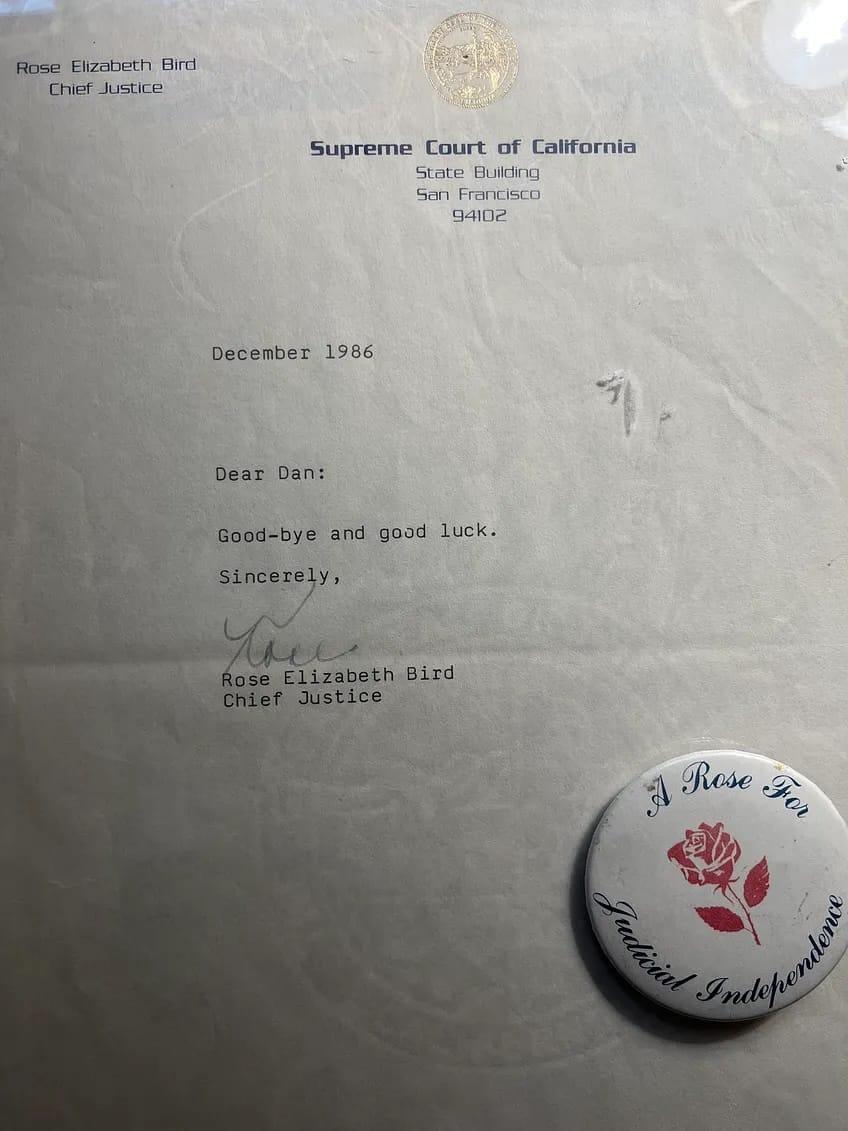
In a brutal campaign that ended 40 years ago almost to the day, Californians ousted Chief Justice Rose Elizabeth Bird and two other liberal state Supreme Court justices over their rulings against the death penalty.
On Thursday, Gov. Gavin Newsom, a lifelong opponent of capital punishment, took a step that would have been unthinkable in 1986 by commuting the death sentences of California’s 548 condemned inmates, likely relegating them to life in prison without parole.
“I take this action because I firmly believe that state-sanctioned killing is incompatible with California’s values, undermines the foundations of our legal system, and diminishes each of us,” Newsom wrote in a letter announcing the decision. (Under state law, the state Supreme Court must affirm commutations of inmates who had prior felony convictions, most of whom did.)

Golden State is a reader-supported nonprofit publication. Help us remain independent with a tax-deductible donation.
If he is correct — and I believe he is — California’s values are far different than they were on Nov. 4, 1986, the day voters ousted Bird and her fellow justices Cruz Reynoso and Joseph Grodin, each of them appointees of Gov. Jerry Brown from his first two terms in office.
California politics were very different at the time, at least on questions of crime and the ultimate punishment, which I started covering in 1984 when the Los Angeles Times transferred me to San Francisco to report on the California Supreme Court. Death-penalty decisions were the dominant story.
George Deukmejian, the Republican who became governor in 1983 in no small part because of his support for the death penalty, led the 1986 campaign to unseat Bird, Reynoso and Grodin.
 Dan Morain

By knocking off the three Brown appointees, Deukmejian was able to appoint their replacements, giving Republican nominees control of the seven-member court well into Brown’s second stint as governor.
Reynoso and Grodin voted against most death sentence cases, but voted to affirm a handful, unlike Bird, who found reason to vote against the 60-plus death cases that came before her, enraging conservatives and the families of the victims of murderers who filled an ever-expanding death row.
California agricultural and business interests stung by decisions expanding the right to sue and Bird’s support for farmworkers helped fund the campaign. But those issues remained in the background. The public campaign focused on the death penalty, for strategic political reasons.
The L.A. Times political writer John Balzar summed up a 1985 Times poll showing that 75% of voters favored the death penalty by saying that “their feelings are so unshakable that most say they would not change their minds even if an innocent person were executed or if their own mothers ended up on Death Row.”
Fred Karger, a young operative working for the Dolphin Group, a political consulting firm that helped propel the political careers of Ronald Reagan and Deukmejian, led the effort to organize grieving families of the victims of death-row inmates.
Years later, Karger told me that he helped organize the victims of Willie Horton, the murderer who committed a rape while on furlough from a Massachusetts state prison during Michael Dukakis’ time as the Bay State governor. Horton’s visage in infamous ads helped destroy Dukakis’ presidential campaign against Vice President George H.W. Bush in 1988.
Times do change.
In 2008, Karger campaigned against Proposition 8, the initiative to ban gay marriage in response to Newsom’s decision as San Francisco mayor to issue same-sex marriage licenses. Karger took on a far more public role in 2012 when he ran in the New Hampshire Republican primary as the first openly gay presidential candidate. But I digress.
 Paul Thornton

Deukmejian’s history with the death penalty dated to his early days in politics, and a ruling in February 1972 by an earlier state Supreme Court. In a 6-1 decision, Chief Justice Donald Wright, an appointee of Gov. Ronald Reagan, concluded that capital punishment violated the California constitutional prohibition against “cruel or unusual punishment.” Wright wrote:
“It degrades and dehumanizes all who participate in its processes. It is unnecessary to any legitimate goal of the state and is incompatible with the dignity of man and the judicial process. Our conclusion that the death penalty may no longer be exacted in California consistently with article I, section 6, of our Constitution is not grounded in sympathy for those who would commit crimes of violence, but in concern for the society that diminishes itself whenever it takes the life of one of its members.”
The decision didn’t stand long. At Reagan’s urging, Deukmejian, then a state senator, placed on the November 1972 ballot a state constitutional amendment specifically authorizing the death penalty.
The death penalty may seem like a relic in a state that hasn’t carried out an execution since 2006. But prosecutors in any county in California can ask a jury to return a death sentence against a murderer whose crime is especially heinous.
Voters in 2012 and 2016 voted against ballot measures to strip capital punishment from the constitution. The death penalty remains a part of California law, despite Newsom’s action on Thursday.
 Golden State staff
Newsom telegraphed his decision before he was elected. As a gubernatorial candidate in 2018, he told Laurel Rosenhall, then of CalMatters and now of the New York Times, that he had met with Brown, himself a lifelong opponent of the death penalty.
“I told Gov. Brown the other day to solve this before the next governor comes into office. … I said, ‘What are you doing, what are you going to do,’” Newsom said.
Brown left office without commuting death sentences. Newsom wasn’t going to leave the job unfinished. With his decision on Thursday, Newsom spared Gov.-elect Xavier Becerra from having to deal with the issue.
As he embarks on a campaign for president, Newsom no doubt will get some support from death-penalty opponents and perhaps from voters who appreciate it when politicians take stands. He’ll also face attacks for having lifted the death sentences of serial killers and child murderers.
Newsom imposed a moratorium on executions in 2019, shortly after taking office, and has said opposition to the death penalty is a basic to his beliefs, instilled from an early age by his father and grandfather. I have no reason to doubt that, but the timing, coming after Election Day, had a political element.
 Mariel Garza

Issuing the commutations earlier would have complicated Democrats’ campaign messages. Perhaps it also would have affected the outcome of two little noticed but important campaigns. Forty years ago, 67% of the electorate voted against retaining Bird. Although there have been no other serious campaigns against California Supreme Court justices since, the precedent remains.
By waiting until after election day to issue the commutations, Newsom provided some protection for two sitting justices on the ballot, Kelli M. Evans, a Newsom appointee, and Joshua Groban, a Brown appointee. Each received more than 70% of the vote. What a difference 40 years makes.
Golden State is a reader-supported publication. Help us stay independent by upgrading to a paid subscription.


