

City Councilmember Nithya Raman’s election as mayor is a big deal to L.A. cyclists. As someone who’s biked thousands of miles across Los Angeles, I haven’t felt this optimistic since former Mayor Antonio Villaraigosa broke his right elbow on a bike ride 16 years ago, had an epiphany and subsequently oversaw a boom in new bike lanes.
His two successors squandered that progress and presided over a lost decade for street safety. Eric Garcetti pledged in 2015 to eliminate all traffic deaths within 10 years, a period that ended with record-high carnage on L.A. streets. In response, Los Angeles voters overwhelmingly passed Measure HLA in 2024, requiring the city to implement its own street-safety plan. Outgoing Mayor Karen Bass has been accused of ignoring that voter mandate, even as traffic deaths continue to outnumber criminal homicides in the city.

Golden State is a reader-supported nonprofit publication. Help us remain independent with a tax-deductible donation.
Raman didn’t have to break any elbows to see the light on street safety. She has embraced Measure HLA and advocated for transportation reforms that prioritize Angelenos who get around without a car. Though she recently tempered expectations by acknowledging harsh budget realities, the incoming mayor has given every indication she will use her appointments to key City Hall posts and L.A. County’s Metro board to chart a vastly different course on transportation than Bass.
Here are my swing-for-the-fences recommendations to Raman for speeding down that course.
Limit cars on roads through parks
Raman has experience with this in her own district. Crystal Springs Drive through Griffith Park acts as a bypass for the adjacent 5 freeway, complete with its own on- and off-ramps to the busy interstate. For about a mile and a half, it's actually two one-way roads, and the co-mingling of commuter traffic with cyclists, runners and others had deadly consequences.
This year, the city removed one lane of vehicle traffic from each direction and installed protected bike lanes, a project championed by Raman. But that reflected what was possible, and here’s what’s ideal: Close one level of road completely to cars, creating a mile-and-a-half ribbon through Griffith Park for cyclists, runners, walkers and everyone else to roam safely.
Raman should also look at limiting car lanes on the high-speed roads through Elysian Park, Sepulveda Basin and Wilshire Boulevard through MacArthur Park. If a road endangers park users, consider cutting off the cars.
 Mariel Garza

CicLAvias every weekend
Sunset Dunes Park in San Francisco started as weekend closures of the former two-mile Upper Great Highway to cars. Given the chance to experience a better, more community-friendly use of the road, voters opted in three separate elections to keep the park and ditch highway permanently.
Could something similar happen in Los Angeles? Here, we have CicLAvia and other occasional festivals that open streets to walking, biking and whatever else people choose to do in the absence of cars. They’re a huge hit, and they should happen more often.
One way to do that without too much controversy is to identify streets with significant reductions in traffic outside rush hour and close them to motorized vehicles on the weekends. Communities come alive in special ways when people can access their streets without fear of getting run over – think of the farmers markets throughout the city every week.
Make it safe and easy to bike to LAX
I’ve found riding my electric bike the only reliable way to time my arrival at Los Angeles’ infamously traffic-choked airport. But I cannot in good conscience recommend this for anyone but the most hardened of cyclists, because the roads leading into the airport tend to be dangerous.
Things are changing somewhat. Protected bike lanes were included as part of the offsite rental-car facility and long-term parking projects, and the new Metro rail station that will (eventually) serve the LAX people mover has parking for bikes, but only for short-term users.
It’s something, but a better option is to rework the controversial $1.5-billion airport super-roadways under construction to build protected bike access straight to the terminals. And make it conspicuous, so the drivers stuck in the dreaded LAX “horseshoe” traffic notice the cyclists breezing past them.
 Jon Regardie
Establish key cross-city arterials for cyclists, scooter riders and others
Experienced cyclists know what roads to skip, no matter what Google Maps murderously suggests. I’m still proud of the fact that I stitched together 23 miles of mostly off-the-beaten-path streets to commute by electric bike to the L.A. Times office in El Segundo, but most people don’t plot their routes that way.
Long, uninterrupted stretches of safe routes for cyclists are hard to find in Los Angeles. Too often the blessedly protected lanes suddenly dump riders into pothole-filled speedways. I got a taste of this on election night when I biked along Hollywood Boulevard between parties for Raman and Bass. Going west, the protected bike lanes end at Gower Street, suddenly turning a relatively worry-free ride into a battle for life.
Los Angeles passed up a huge opportunity when Metro failed to include dedicated bike lanes in its 12-mile Vermont Avenue transit corridor from Sunset Boulevard in Hollywood to 120th Street just south of the 105 Freeway. That prompted a lawsuit over the city’s failure to implement Measure HLA.
Raman has embraced Measure HLA, so perhaps L.A. will end up with a bike arterial along Vermont. The city should have a lot more – in the Valley, the Westside and every other neighborhood. Roads that connect people to the places they want to go should be safe for all users the whole way.
What can Raman do right now?
She should direct parking services to crack down on vehicles that block bike lanes. And while she’s at it, tell police officers to stop parking their cruisers in bike lanes. I see this everywhere. It telegraphs a basic disregard for cyclist safety and gives everyone else permission to block bike lanes.
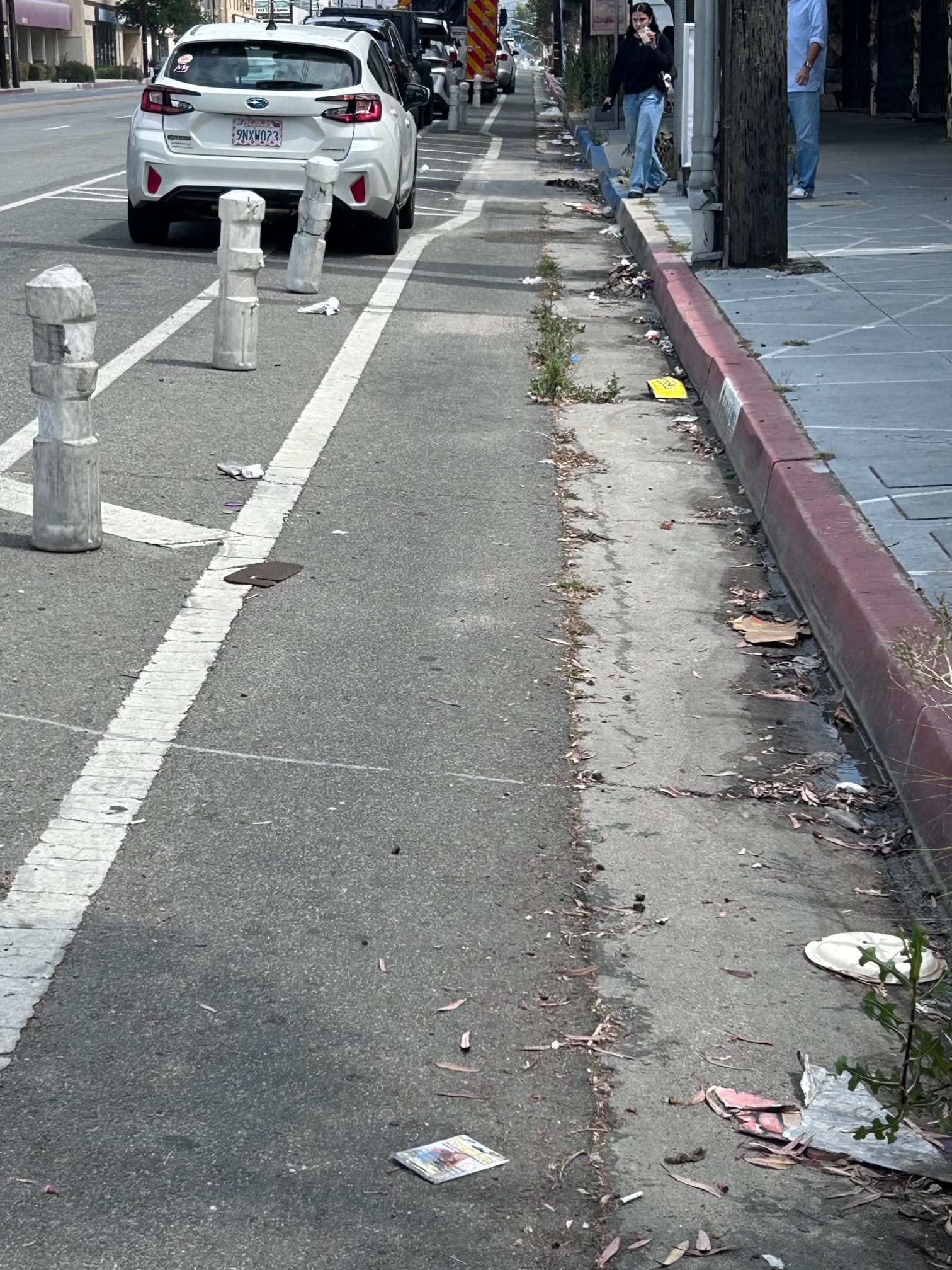
Also, protected bike lanes that already exist need to be cleaned more often. Trash, glass and other items tend to accumulate near curbs; add the bollards that often make protected bike lanes too narrow for street sweepers, and you have a messy, hazardous situation for cyclists.
With just a few key policy changes, Raman could establish herself as the person who started the transformation of L.A. into a place where its streets are just as welcoming as its weather to cyclists, walkers and anyone else outside a car.
What a city that would be.
Golden State is a reader-supported publication. Help us stay independent by upgrading to a paid subscription.


