

Adam Henig is the author of four books, including his most recent, “Baseball’s Outcast: The Story of Ron LeFlore.”
When I first saw L.A. native Beck in concert, it was 1997 during his tour supporting his second album with a major label, “Odelay.” My high school friends and I paid a mere $15 apiece for our floor tickets at the Henry J. Kaiser arena in Oakland (floor tickets to upcoming shows in San Francisco are now going for $200). It was a great, albeit brief, performance.
A few years later, I saw Beck again. This time it was on the other side of the Bay, at the much larger Bill Graham Civic Auditorium in San Francisco, promoting his 2005 album “Guero” ( “white boy” in Spanish). No floor seats this time; I parked myself on the balcony.
By that point in his career, Beck, who fuses all sorts of musical genres — country, rock, hip-hop, folk and electronic — had solidified himself as one of the best live acts in the business. His music had matured as well as his live performance.
But as a fan of Beck’s music, I knew little about the artist behind it. Typically, fans want their heroes’ backstories — where they come from, what makes them tick and so on. With Beck, no matter how many Rolling Stone or Spin magazine articles I read about him and his music, he remained an enigma. Who was this awkward Angeleno making strange yet compelling sounds?
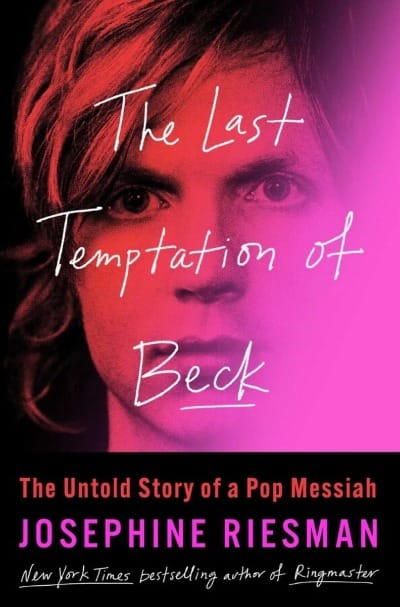
So when I came across Josephine Riesman’s upcoming book, “The Last Temptation of Beck: The Untold Story of a Pop Messiah,” I was intrigued, even giddy, to finally learn about Beck. Fortunately for Beck fans, Riesman provides an unvarnished view about one of modern rock’s most innovative pop musicians, including his nearly lifelong association with Scientology.
Born in Hollywood in 1970 into a Scientologist family, Beck has an extensive artistic pedigree. His father, David Campbell, was a respected Los Angeles-based musician and producer who had worked alongside such prominent performers as James Taylor, Cat Stevens and Linda Rondstadt. Beck’s mother, Bibbe Hansen, was a New Yorker and a devotee of Andy Warhol. Bibbe’s father was Al Hansen, the internationally recognized prolific mid-20th century artist known for pushing boundaries.

Smart money vs. dark money: Support Golden State’s reporting and analysis on all 14 propositions on the Nov. 3 ballot by making a tax-deductible gift. It’s the smartest donation you can make this election cycle.
Beck’s affiliation with Scientology began with his parents (grandfather Al was not a fan, according to Riesman). When Bibbe moved to Los Angeles in 1969, the controversial religion — which Riesman contends is a cult — was at the epicenter of the “new religious movements [that] sprang up like mushrooms” (think Charles Manson) throughout the region, attracting all sorts of young people desperate for new beginnings and adding “meaning to [their] existence.” Most faded into obscurity, but the church with storefronts all over Los Angeles and the San Fernando Valley hawking its foundational text “Dianetics” in the windows would have the most staying power.
Shortly after her arrival, Bibbe met her future husband David, who was already a church member, at a Scientology recruitment meeting. They quickly married and she became pregnant with their first child, Beck (or “Bek,” as it was originally spelled). The young family was able to live in the Scientology’s Celebrity Centre in Hollywood, elevating their status within the religion’s strict hierarchy. Riesman explains that coddling entertainers and artists such as the Hansens was one of the ways Scientology’s founder, L. Ron Hubbard, expanded recruitment and forever linked his church to Los Angeles (even though Scientology is headquartered in Florida).
 Paul Thornton
Riesman spends a considerable amount of her book on the inner workings and history of Scientology as a way of explaining the titular character. However, there are moments when she digresses in subplots — for example, two female fans obsessed with Beck wrote an underground “zine” about him and later have a strange altercation with his mother. And the back-and-forth between Beck and Scientology – his on-again, off-again affiliation with the church – while those in his orbit manipulated and isolated him from reality, was, at times, tricky to follow.
If you’re expecting a traditional biography that delves deep into Beck’s music catalog, Riesman’s book isn’t it. But that doesn’t seem to be her intent with “The Last Temptation of Beck.” Riesman, who has also written biographies of comic book writer Stan Lee and wrestling mogul Vince McMahon, knows how to tell a story. And the trajectory she lays out of how the elusive and confused Beck went from having a distant relationship with the religion he was born into to becoming a devoted member (but not to the extent of Tom Cruise) – before saying in 2019 he had broken from it – is fascinating, if confusing at times.
“The Last Temptation of Beck” is an absorbing analysis of how a talented, trail-blazing musician could also be a lost and troubled soul.
What do you think? Golden State Report is a public forum. Send your responses for possible publication to forum@golden-state.org. And sign up for free to make sure you don’t miss anything.


