
Katherine Contreras Hernandez is an award-winning journalist from the San Fernando Valley who focuses on community stories and Latino issues. She is co-executive editor of USC's student-run Annenberg Media. This piece is part of "Resilience in the Age of ICE," a series of podcasts and essays produced by students in the USC Annenberg School for Communication and Journalism and published by Golden State. The complete series can be found here.
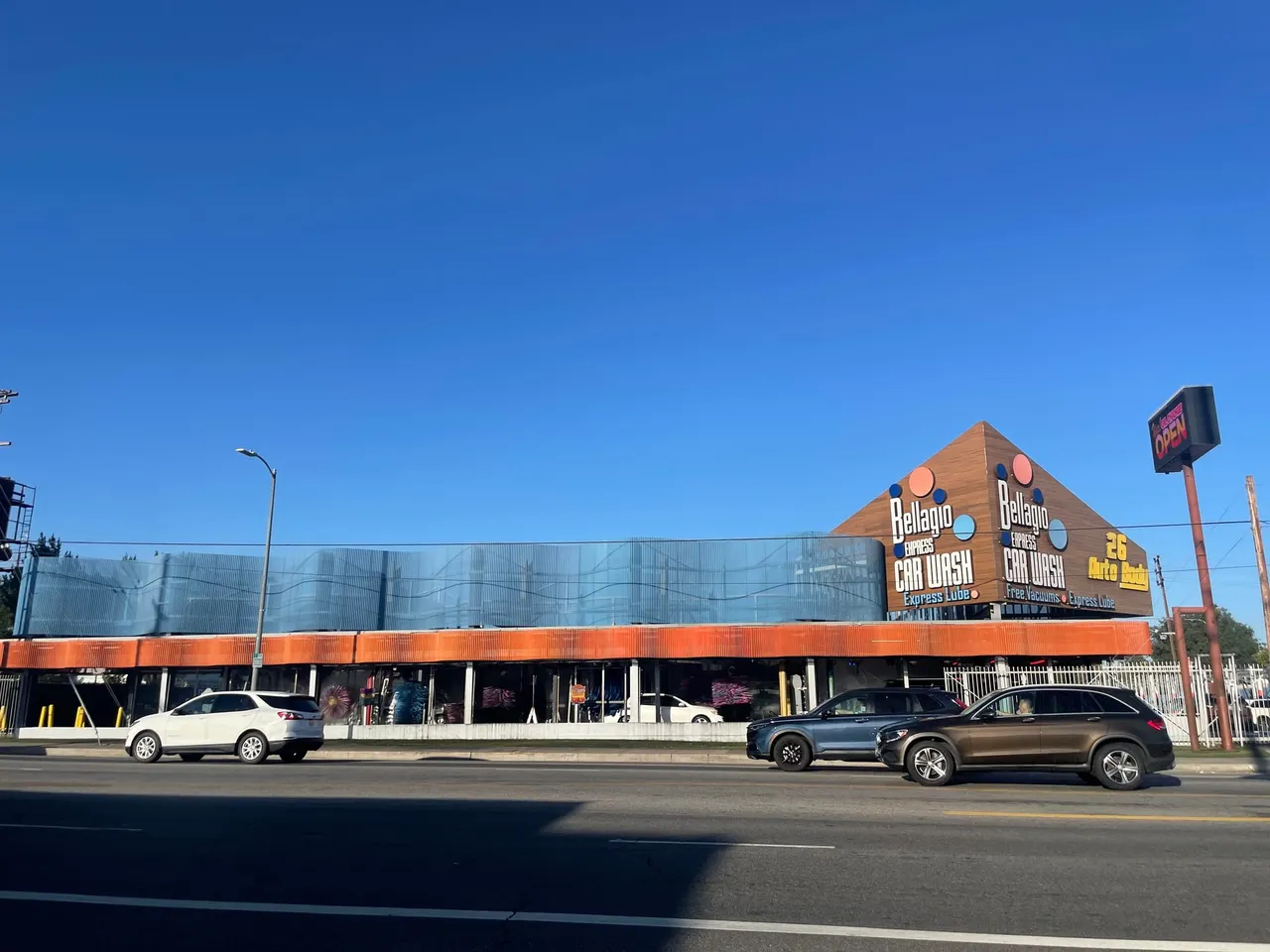
June 16, 2025, seemed like another normal summer day at a local car wash in the San Fernando Valley. The general manager and the workers opened the establishment and were servicing cars as usual. Despite the heat, which would later hit a high of 84 degrees, nothing seemed out of the ordinary.
That is, until around 8 a.m.
“Someone called me letting me know that they were around. They were close by at the local Home Depot. And then I got a second call from someone else, like 15 minutes later,” said the car wash manager. He spoke on the condition of anonymity, due to his fear of retaliation by his employer.
The manager said that the staff at the car wash was warned that Immigration and Customs Enforcement was in the area and had moved from a hardware store to a grocery store nearby. “They kind of gave us head’s up so we [were] ready,” he said.
Suddenly there were about five vehicles belonging to ICE outside. “They're blocking the main entrance, the side entrance, and one came in the runway,” the car wash manager said.
 Guest Contributors
The car wash manager said that they initially approached one worker and asked for “his papers” before moving onto a second and third worker. All three showed documentation.
As all this took place, he recalled, “I just radioed my supervisors, and then whoever felt not secure [in their status] went to the office and locked themselves in.”
The manager said that outside, the ICE agents appeared dissuaded by their conversations with workers who had legal status. They no longer seemed interested in taking people because it seemed like there was no one to take.
They remained on the premises but left soon after. In total, the entire exchange took 20 to 30 minutes, according to the car wash manager.
No one was taken by ICE, and the car wash manager credits this to his employees' reactions. “Nobody panicked, nobody really ran or took off,” he said. “That's what made the difference.”
Others in the San Fernando Valley and across Los Angeles have not been so lucky.
CLEAN, a car wash worker center in Los Angeles, has said that between June 6 and Dec. 5 last year, more than 350 car wash workers were disappeared.
ICE agents in Los Angeles have targeted everyone from gardeners to street vendors and even people simply heading for the bus. Their targets have primarily been Latinos, and according to a statement put out by the Department of Homeland Security in December, they've had more than “10,000 arrests” since June 2025.
They describe those taken as “illegal aliens — including murderers, kidnappers, sexual predators, and armed carjackers.” However, investigative reporting by various news outlets has revealed that despite high numbers of arrests, many of those taken have no history of a criminal record. CBS reported in February that according to an internal DHS document, less than 14% of nearly 400,000 immigrants arrested by ICE in President Trump's first year back in the White House had charges or convictions for violent criminal offenses.

Just $33.33. It's less than a tank of gas or a bag of groceries. But that's all it would take from each of our readers to keep Golden State going through 2026.
In Los Angeles, the ZIP code hit the hardest by ICE is 91402, according to a study by the county’s Department of Economic opportunity and the Los Angeles County Economic Development Corporation. The ZIP code comprises the San Fernando Valley communities of Mission Hills, Panorama City and North Hills and is about 70% Hispanic, according to U.S. Census data.
Despite this, the mainstream media has largely ignored ICE activity in the Valley.
“I think that the Valley in general is neglected in ways by the greater Los Angeles. It's like half the population of the city of L.A. and yet most of the focus is on the other side of the hill,” said Semantha Norris, a reporter for The San Fernando Valley Sun/El Sol.
Norris has reported on the Valley for years, and her reporting about ICE activity in the Valley includes coverage of violence by federal agents against residents. For example, she told the story of Matilde, a woman in Pacoima who suffered a heart attack after ICE agents forcefully detained her as she sold tamales on the street near a Lowe’s.
Matilde’s story did make it to the Los Angeles Times, three weeks after Norris’ reporting, but that was an exception.
“The reason that I was able to get that story at The Sun and to address it quickly is because when you work for a local community paper, you're a part of the community, and you're talking continuously with the community and knowing what's happening in the area surrounding where you're reporting,” Norris said. “When you're working at a big publication like the L.A. Times or Univision, or Telemundo, it's hard to be tapped in that same way often times.”
 Daniela Mattson
But Norris’s coverage did not come without a personal cost.
“I think when you're reporting on something that is very personal or that hits close to home, it's hard. It's hard to see people go through something that you know could have been your family member,” she said. “You take on a lot of people's pain in a way.”
Community journalists like Norris have been able to illuminate how ICE has been operating in the Valley amid a broader underrepresentation of the region in news coverage. Norris’ experience also shows how the raids of ordinary workplaces cause pain for residents across the Valley and L.A. County, even those who were not targets in those raids. Carlos Amador, the economic justice manager for CLEAN, explained that when someone is taken from a local business, the impact reverberates “both emotionally but also economically.”
He explained that when a worker is taken by ICE, their entire family may struggle financially due to a sudden lack of income from a primary breadwinner and may experience issues like food insecurities and high legal costs.
Moreover, the community loses out on possible economic opportunities as well. “It's one less source of income for the economic output related to, you know, purchasing, going out, frequenting different businesses in the community,” Amador said.
To the car wash manager, this loss of economic opportunity rings especially true.
 Jon Regardie
“People didn't want to come out of their house and go to work here that day after they left,” he said. “Whoever wasn't comfortable, they asked to go home. So I ended up running with a skeleton crew. People from other locations had to come and help me, because it was a busy day, and to get through the day supervisors and managers from the other locations showed up. Then I had a couple guys that were not comfortable coming in the next day and the following days.”
He added that upper management was supportive of those workers, but the habits of some of the workers changed. “I noticed some of my guys, they were taking breaks in break rooms where there's a door, when they can lock it if anything happens,” he said.
But for many, not going to work was not an option. “Reality is that even if they were scared, people need to eat,” he added.
The car wash manager knows this personally. He said even some of the business’ customers who worked in landscaping or construction told him they were afraid to go to work.
Sergio Amalfitano, a record store owner in the city of San Fernando, is well aware of how the raids changed daily life in the Valley. “From the strictly business-owner standpoint, you see diminishing returns of customers. You see the block is dead a majority of the time,” he said.
He echoed Norris’ opinion that many people were not paying attention to the Valley when ICE arrived last summer. Although people spoke about ICE “hitting L.A. hard,” he said, they didn’t speak about the Northeast Valley specifically.
But, he said, the raids were nonstop. “There was, like, I don't even know, a couple months where they were just consistently at the same, you know, the San Fernando Home Depot, or the Pacoima Lowe's, or, you know, the North Hollywood Home Depot. So for a minute it was very intense,” Amalfitano said.
Amalfitano has been a loud advocate against ICE since the agency's presence became known in the Valley. For him, his advocacy is not just about his feelings, but also his family history.
 José M. Alamillo
His parents immigrated from Argentina during the 1970s as a result of the dictatorship and the Argentine Anticommunist Alliance. Amaltifano said the alliance was made up of people who “would basically drive around in cars and just grab whoever they didn't like, you know, if you were a socialist or if you were an immigrant or you're Brown, or if you were a kid with long hair.”
He said that this informed his view of ICE activities and therefore his need to speak out.
“I think you should abolish ICE, I don't think legal status matters,” he said. But he believes the federal government was disingenuous about whom it was targeting. “Their goal was clearly just to intimidate people and to essentially make people fearful to do their daily routines.”
Amalfitano decided to use his establishment as a place where people could become informed and feel safe. The Midnight Hour has given out red cards, helped coordinate donations for others to shop for those fearful to leave their homes and even hosted know-your-rights sessions, most recently one for the high school students who participated in massive walkouts in February.
“We function as a business, but what is a business without community support? What is a business without it in turn, supporting its own community? We're here when the times get tough and when the time gets tough, we want to again at least mitigate as much harm as possible,” he said.
Amaltifano feels that incidents like the one at the car wash and the Home Depots in the area cause residents to feel unsafe going about their routines. “They're definitely stoking the fires of having the fear of just kind of living your daily life to the point where I know a lot of people that are considering kind of just leaving the country and, you know, ‘self deporting,’ because they're like, ‘Why would I live this way?’”
A report from UCLA's Center for Neighborhood Knowledge shows that “in 2025, the number of noncriminal Latino ICE arrestees entering detention each month increased sixfold during the first eight months of the Trump administration compared to the Biden administration.”
Places like Home Depot parking lots and other car washes have been heavily targeted by ICE due to their workforce being made up of mixed-status workers. White House Deputy Chief of Staff for Policy Stephen Miller reportedly directed ICE’s top field heads to conduct raids at workplaces such as Home Depot and 7-Eleven. Months later, a New York Times article revealed that Homeland Security agents investigating sexual crimes against children had been directed to focus instead on undocumented immigrants.
However, in recent months, raids in the San Fernando Valley are visibly down. This could be due to the fact that the U.S. 9th Circuit Court of Appeals has maintained restrictions on immigration raids in Los Angeles, or due to the Trump administration’s redirection in response to outrage after federal agents fatally shot two white U.S. citizens in Minneapolis.
Meanwhile, residents of the San Fernando Valley continue to rally around the undocumented community. Mutual aid groups like Amor al Valle are raising funds for groceries for those impacted by ICE. After the attempted raid occurred at the car wash, a lawyer brought the manager a document he said would facilitate legal representation for anybody who was detained.
Still, ICE’s impact continues to be felt by residents. “There's definitely a sense of, like, overwhelming kind of dread and of being watched,” Amalfitano said.


