

Jim Newton is an author and journalist who worked for 25 years as a columnist, editor, reporter and bureau chief at the Los Angeles Times. He teaches at UCLA and founded Blueprint magazine. This commentary was originally published by CalMatters. Sign up for their newsletters.
Los Angeles’ effort to restore iconic MacArthur Park to health has all the trappings of a test: It is a challenge, it requires effort and staying power, and its results will either validate a theory or debunk it.
The theory: The right blend of police power, community involvement, social services and attention to detail can produce lasting, transformative change in an area of the city that has succumbed to addiction, crime and homelessness.

Golden State is a reader-supported publication. No billionaires tell us what to do. Help us to stay independent with a tax-deductible donation.
The grade: Incomplete.
MacArthur Park was once a symbol of Los Angeles: noir, edgy, surrounded by swanky hotels, the subject of song and myth. More recently it has become a symbol of what’s wrong. Drug addicts scramble for fixes; sidewalks and alleys smell of urine; criminals prey on the helpless.
City officials made a commitment to turn the park around — if not back to its mid-century glory, at least to someplace neighbors could enjoy. The neighborhood the park occupies, Westlake, is home to immigrants from around the world and one of the most densely populated communities west of the Mississippi.
City agencies and nonprofits have dispatched overdose teams and social workers to the park, to help addicts drawn there by the availability of drugs. The Los Angeles Police Department has stepped up patrols, which has disrupted a flourishing drug trade along Alvarado Street, on the park’s eastern edge.
 Oscar Garza
The park feels safer and cleaner than it did a year ago. Nevertheless it remains torn, and its future is tenuous.
As one recent report concluded: “While the current day conditions of the park are controversial topics for people within and beyond the Westlake neighborhood, there is a commonly held desire for clean, well-maintained green space, that is safe, accessible, and a great destination for families; a vibrant space activated by people who are enjoying the park.”
That prospect remains more hope than present-day reality. And so, the city’s work is evolving, not so much leaving behind the effort of the past year or so but enlarging it, to employ urban planning tools to change the look and feel of the park. The hope is that amenities and alterations to the flow in and around the area will build on the modest progress of recent months and solidify some of the gains.
That notion got a test run earlier this month, when the city cut off car traffic from Wilshire Boulevard, a major street that cuts the park in half, from east to west.
 Paul Thornton
It was only temporary, but the idea was to try out the park as an uninterrupted patch of land. Under normal conditions, the boulevard interrupts the feel of the park by slicing it with a street so wide and flanked with barriers that the only simple way of getting from the north side of the park to the south side, or back, is by walking through pedestrian tunnels, which can be dark and intimidating.
But on the weekend of July 17, the street was closed to all but pedestrian traffic, and park-goers could experience it as they did a couple generations ago.
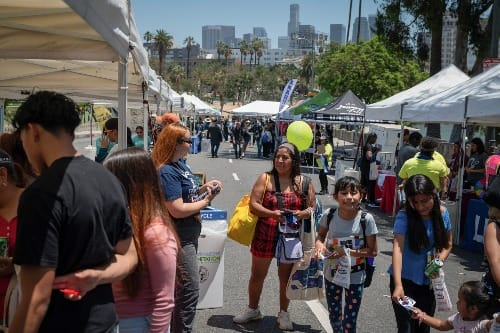
Crowds turned out – some 2,000 on Friday, almost twice that many on Saturday. Some came out of curiosity, some to watch the World Cup, some to participate in festivities created for the day.
Not all of the park’s ills were in remission. The eastern edge, along Alvarado, still had a smattering of glassy-eyed addicts lolling on benches or splayed on the ground. There was litter in spots.
But there also were kids playing soccer, vendors selling food, families with young children joining in carnival games set up for the day. Some unhoused people lined up next to families and kids to watch the games.
If it were permanent, rerouting Wilshire Boulevard would be a major undertaking, and it’s only in the early stages. But it was the recommended option of a recent park study, and it’s moving to its next phase, an environmental review that will include mountains of community input. The feedback gathered so far has been overwhelmingly positive, according to the report.
 Dan Morain
Other physical improvements are underway, too. For a while, the city moved against illegal street vendors — and the drug trade they permitted — by installing chain-link fences along stretches of Alvarado and adjoining streets. That helped chase off drug dealers, but the fences were unsightly, and people started tossing their trash into the fenced-off enclosures. Responding again, the city installed colored bollards — big cement spheres — that impede vendors but can’t be used as trash receptacles.
Some of the people who turned out last week were happy to see the fences gone but noted that some drug dealers merely moved a few blocks away. It’s easier to move a problem than it is to eliminate it, especially one as persistent as drug trafficking.
The next major change to the park is expected in the fall. It, too, is an attempt to address the look and feel of the area. Planners are working on a wrought iron fence to encircle the park, controlling access and making it easier to enforce its closure at night.
 Karin Klein
Not everyone likes that plan. Some residents view the fence as a symbol of exclusion or a waste of resources better spent on housing or drug treatment. But it holds in common with blocking Wilshire or the bollards the idea that changes to the park’s physical environment might have lasting effects on its social conditions.
The goal is not to drive out the forces of decay but to invite in those of stability.
These are difficult problems, microcosms of larger struggles Los Angeles and other big cities face, especially at a time when Washington has forgotten them or, worse, contributed to them. In MacArthur Park, for instance, the city’s efforts have been stymied at times by the Trump administration’s decision to use the park as a staging area for its faux military operations, complete with ICE agents dressed up as soldiers parading in front of bewildered residents.
MacArthur Park is not a staging area. It’s the center of a tightly packed, immigrant community whose residents depend on this space for children to have a place to play and for residents to gather for rest from long days and nights of work.
These residents have all the same rights to safety, health and peace of mind as do wealthier Angelenos. They deserve this effort.
It is a test the city must pass.
What do you think? Golden State is a public forum. Send responses for possible publication to forum@golden-state.org.


