

Richard Barton is a political scientist at Syracuse University and senior research fellow at Unite America, a philanthropic venture fund that invests in nonpartisan election reform to foster a more representative and functional government.
California’s governor’s race is drawing outsized national attention because of the possibility, however remote, that this deep-blue state could feature two Republicans on the ballot in November.
To some observers, especially Democratic Party insiders, that exposes a glitch in California’s top-two primary system. But same-party matchups are actually a feature of these systems, not a bug. And they’re the key mechanism through which top-two primaries reduce polarization.

Just $33.33. It's less than a tank of gas or a bag of groceries. But that's all it would take from each of our readers to keep Golden State going through 2026.
California is one of three states, including Alaska and Washington, that uses some kind of open, all-candidate primary for federal offices. Everyone runs on the same ballot and voters can pick their favorite, regardless of their party registration. In California’s case, the top two finishers advance to the general election.
Research shows that top-two primaries don’t just give voters more choice and power at the ballot box. They change what candidates have to do to win. When two candidates from the same party face off in a general election, they compete for the entire electorate, which includes independents, moderates and even voters from the other party. The result is more dynamic campaigning and coalition building. For example, when canvassing, these campaigns knock on all doors rather than just targeting voters from their own party.
In California, same-party general election matchups occur in roughly 20% of races — the vast majority of those being two candidates from the dominant party in a district. In 2024, for example, Assembly districts 52, 54 and 57 in Los Angeles each sent two Democrats to the general election. In those elections, candidates actually have to persuade voters who don’t already agree with them. And that changes not just how they campaign, but how they govern.
The results are measurable. According to a study from Christian Grose, a professor of political science at University of Southern California, candidates elected under top-two primaries — particularly new legislators — are significantly less ideologically extreme than those elected under closed primaries.
But you don’t need political science to see how this works in practice.
In 2016, two San Francisco Democrats — Scott Wiener and Jane Kim — advanced to the general election for a state Senate seat. Kim ran as the progressive favorite and finished first in the all-candidate primary. In the party primary system used in the other 47 states, Kim would have been the assured winner against the Republican candidate in this deep-blue district.
Instead, Weiner, the second-place winner of the primary, won in the general election, where the electorate was larger, more diverse and less ideological. He did that by building a broader coalition with support from independents and moderate Republicans as well as Democrats. Once in office, he became one of the leading champions of California’s “abundance” agenda, authoring major housing reforms to increase supply and reduce costs.
Critics are using the possibility that Democrats could be shut out of the governor’s race as evidence that the system doesn’t work, and a reason to repeal it. It’s an understandable concern, especially from the party’s perspective, but this kind of same-party matchup is exceedingly rare outside of safe seats. In the few cases where two candidates from the minor party advanced, the outcome hasn’t lasted. When Democrats were locked out of a safely blue California congressional seat in 2012, they won it back in the very next election. The system corrected itself.
Compare that to what happens under closed party primaries, where candidates with extreme views can win by appealing to a small, highly ideological slice of voters and then hold power in safe seats for years with little accountability.
 Mariel Garza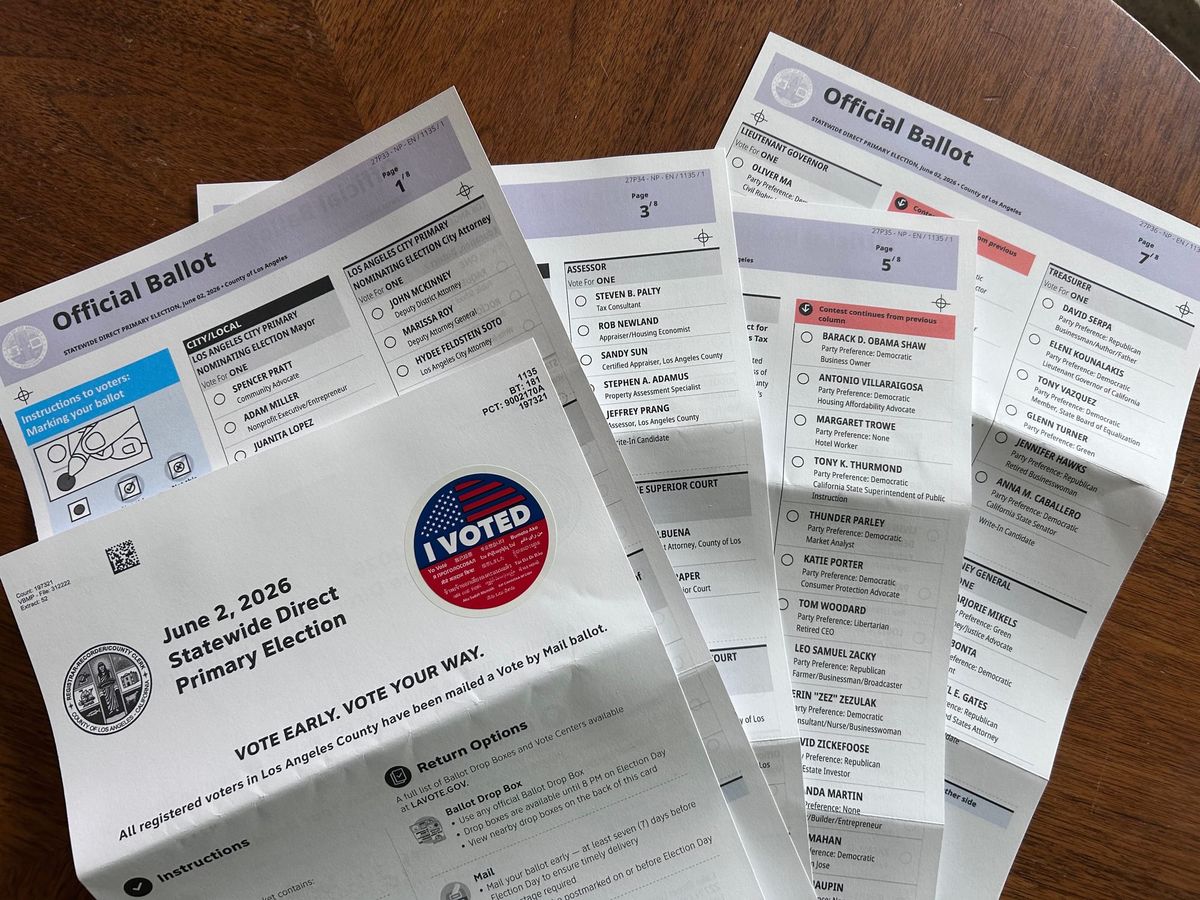
A Republican-versus-Republican general election in California would be unusual.
But if it did happen, the positive impacts of same-party matchups would still apply. Both Steve Hilton and Chad Bianco would have a strong incentive to appeal to more liberal voters. They couldn’t govern the state without making allies in the Democratic-controlled Legislature. They’d be incentivized not just to appeal to their bases, but compete for a broader coalition.
And that’s the point and the power of top-two primary systems.
The debate over California’s primary system often gets lost in hypotheticals and edge cases. But the underlying mechanism is simple: Replace two low-turnout partisan primary elections with a single election with the entire electorate, and you radically change the incentives for candidates. Change the incentives, and you change who runs for office, how they campaign, and how they govern.
BOGO alert: This month only, new subscribers to Golden State also get a bonus paid subscription to Laughing Leads to Crying, a newsletter by the talented Josh Gohlke.


