

Diana Daniele is an author and publicist in Los Angeles.
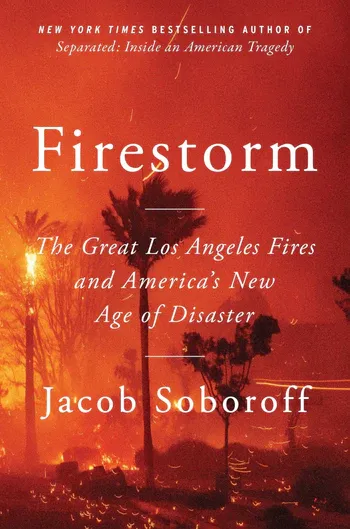
Reading Jacob Soboroff’s “Firestorm,” the first book by a journalist on the devastating Los Angeles fires more than a year ago, I kept recalling my own evacuation from Pacific Palisades in January 2025.
The memories of that afternoon are still painfully fresh: My pounding heart felt as if it might spring from my chest as I pulled out of my garage. Ash and soot whirled outside my front windshield as I turned onto Palisades Drive. I held my gaze on the police escort, but I still saw the blackened trees and burnt-out chaparral on each side of the canyon.
On Sunset Boulevard, I could see a dozen abandoned cars that had been driven onto the center median, as if they tried to flee the fires by themselves. Some were hollowed out, with red flames still licking the air through shattered windows.
When the heat from the terrifying flames engulfing either side of Palisades Drive at Sunset reached me, I instinctively went to brake. But there was no turning back. As in so many instances in life, the only way out was through.
By now, the statistics are familiar: The 2025 fires decimated Pacific Palisades in Los Angeles and the unincorporated community of Altadena, killing 31 people, destroying 18,000 structures and burning more than 40,000 acres.
But in “Firestorm,” Soboroff does more than just recount details. He grew up in Pacific Palisades and uses his childhood memories as a lens to view the devastation. His deeply personal perspective should resonate with people like me, who had to flee for their lives from the fire. In a particularly poignant passage, Soboroff talks to his mother on his phone as he surveys the destruction of his “birth house” on Frontera Drive. His mother sobs, and Soboroff chokes up as well, as “tears traced a line through the blackness on my cheeks.”
Soboroff was not alone in his grief. The day I evacuated, I thought the fire was burning only in my Highlands neighborhood, where it re-started at the site of a burn thought extinguished days before. After turning south on Pacific Coast Highway from Sunset, I saw that both the El Medio and Via Bluffs had also been consumed by flames – and realized how vast the destruction was going to be.

No billionaires tell us what to do, but it still costs money to do this work. So, please consider upgrading to a paid subscription and support independent, home-grown journalism.
Looking out at the surreal sky, thick with smoke and framed by an ominous golden-red light, I broke down in tears seeing my hometown burning before my eyes.
Most of Soboroff’s book focuses on the Palisades, but he does cover the Eaton fire and Altadena, a foothill community about 25 miles farther inland. That fire didn’t start until around 6 p.m. on Jan. 7, hours after structures had been destroyed and evacuations were ordered in the Palisades. My neighbors and I were able to flee in daylight; Altadena residents, many of whom did not receive evacuation orders until after 3 a.m. on Jan. 8, had to leave at night when the fire was already upon them.
Soboroff gets political in parts of the book, having had a bird’s-eye view of how Gov. Gavin Newsom, outgoing President Biden, and President-elect Trump responded in real time (he pans the latter for prematurely casting blame and sowing disinformation).
But he also poignantly sets aside politics in places. Soboroff writes of checking on the home of Trump advisor Stephen Miller’s parents, as requested by his wife Katie Miller, whom Soboroff knows professionally.
 Paul Thornton
Though Soboroff could have included more stories from people who currently live in the Palisades, I was grateful to read that his father Steve, who briefly served as Mayor Karen Bass’ recovery czar, was instrumental in temporarily relocating Palisades High School to Santa Monica. My daughter graduated from Pali High after the fire in an epic Hollywood Bowl ceremony where Golden State Warriors head coach Steve Kerr and actor Billy Crystal both spoke, and inspiringly so.
I thought of that moment as Soboroff concluded his book by saying he found hope “in the people, not the politics” after the great L.A. fires of 2025.


