Oscar Garza is director of the Specialized Journalism / Arts & Culture graduate program at the University of Southern California Annenberg School of Journalism. He has been a culture writer and editor at KPCC/LAist, Tu Ciudad magazine and the Los Angeles Times. Editor’s note: In the interest of full disclosure, the dean of the Annenberg School of Communication and Journalism, Willow Bay, is co-chair of the LACMA Board of Trustees.
OK, no pussyfootin’ here, let me just say flat out: Architect Peter Zumthor, LACMA CEO Michael Govan and his staff have brilliantly reimagined the museum-going experience with the new David Geffen Galleries at the Los Angeles County Museum of Art.
The Swiss-born Zumthor, who won the 2009 Pritzker Architecture Prize, used concrete — a material often associated with boxy Brutalist architecture — to design a curvy (dare I say, sexy) building that spans Wilshire Boulevard. (The architecture firm SOM, Skidmore, Owings & Merrill, handled the construction challenge.) Gone is the hodgepodge that included LACMA’s original buildings from 1965, and a 1980s post-modern pavilion that didn’t age well. Zumthor’s structure is more of a piece with the fairly new Renzo Piano buildings that sit across LACMA’s main plaza. And it even lives in relative harmony with the adjacent Bruce Goff-designed Japanese Pavilion from the 1980s.

No billionaires tell us what to do, but it still costs money to do this work. So, please consider upgrading to a paid subscription and support independent, home-grown journalism.
During my visit, I wasn’t handed a map to guide me through the new building. No problem. It turned out it is preferable to wander aimlessly and be surprised at nearly every turn.
Instead of a traditional museum approach that usually presents art organized by epoch and/or a cultural framing, LACMA’s new galleries debut with a presentation that the museum says is inspired by the Pacific, Indian, and Atlantic oceans, and the Mediterranean Sea. That allows for ancient and contemporary works in various media to be seen side-by-side in often thrilling juxtapositions. L.A. artist Lauren Halsey’s new, untitled sphinx, commissioned by LACMA for the new building, fits right in alongside Egyptian artifacts. (There are still thematic galleries devoted to Latin American and Chicano art, and to Southern California car culture.)
There are nitpicks: The floor-to-ceiling windows on the exterior walls — even shaded by specially-made translucent curtains — create glare that doesn’t make for ideal daytime viewing of some artworks. A powerful Francis Bacon triptych painting behind glass is a particular victim of distracting reflections. The optimum visit — at least until Daylight Saving Time ends — might be later on a Friday (open ’til 8 p.m.) or weekends (open ’til 7).
And yet those same windows spanning the second-floor galleries provide lovely panoramic views of the city. Let’s all admit it — architectural taste is purely subjective. One person’s $724 million gem is another’s folly. It will also be interesting to see how future shows are organized. The thematic approach to presenting LACMA’s encyclopedic collection may not always work as well as it does in the debut show. In any case, there will always be catcalls as well as admirers.
But let me propose an idea that should be palatable to all. This radically reimagined LACMA needs to take one more radical step: When the doors open to everyone on May 4, admission should be free for all residents of Los Angeles County.
 Oscar Garza
Currently, tickets for locals range from $21 (visitors with a disability, students who are 18 and older, and seniors who are 65-plus), to $25 for adults. Admission is free for ages 17 on down. And it’s free for everyone after 3 p.m. on weekdays.
But L.A. County provided $125 million to help fund construction of the new building and its residents should get to see it for free every day, all day.
And let’s not forget that L.A. County provides annual operating support to LACMA. For the fiscal year ending June 30, 2025, the museum received $36.7 million in operating support from the county, and took in $4.28 million from admissions. The county could either increase its annual support to make free admission possible, or not provide any additional funds but stipulate that admission be free for county residents. That would leave it to LACMA to come up with the money. Note that the museum would still receive admission revenue from non-county residents — and there will surely be a surge of interest in the new building.
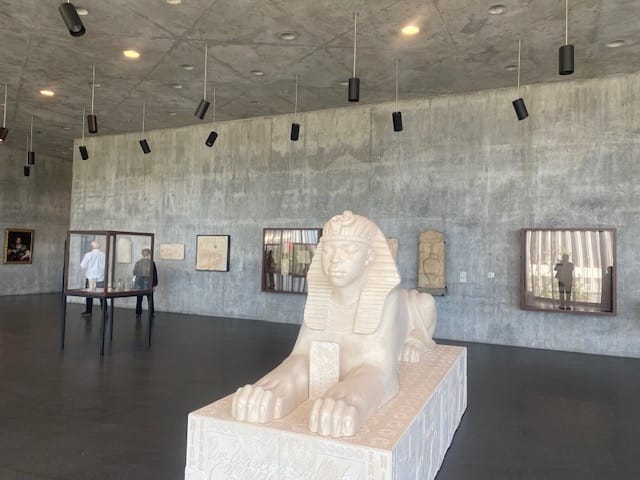
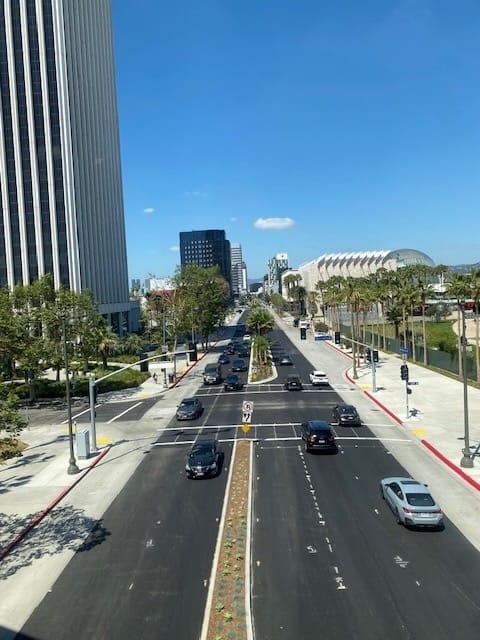
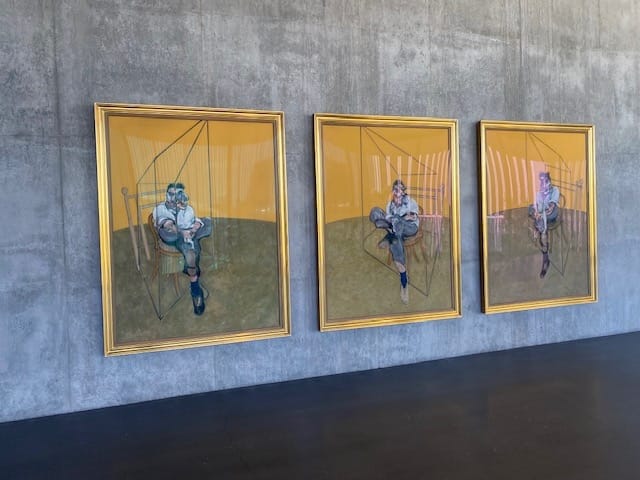
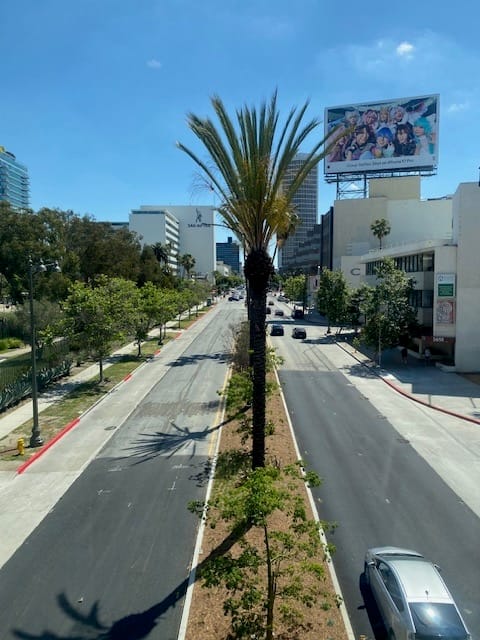
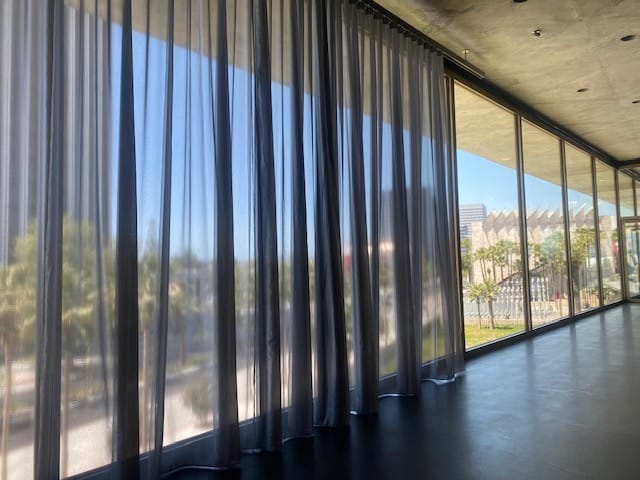
Clockwise, from top left: Lauren Halsey’s sphinx; the view west from the bridge over Wilshire Boulevard; Francis Bacon triptych obscured by glare; the view east from the bridge over Wilshire Boulevard; the infamous curtains. (Credit: Oscar Garza)
In recent years, museums across the country have increasingly adopted free admission policies. At New York City’s Metropolitan Museum of Art, admission for state residents is pay-what-you-wish — and you can pay as little as a penny. Here in L.A., it doesn’t cost anything to visit the Museum of Contemporary Art, UCLA’s Hammer Museum or the Broad (except for special exhibits at the latter). The Getty Museum and the Getty Villa also have free admission, but you have to pay as much as $25 for parking. LACMA’s parking isn’t cheap either ($23), but this month, Metro’s new D Line extension adds a stop across the street from the museum.
So, here’s a memo to LACMA, its trustees and the L.A. County Board of Supervisors: Bravo on the new building! You deserve kudos for the vision and commitment at a time when culture is under attack in this country. But county residents helped finance construction of the new galleries, and we pay taxes annually that help support the entire museum. How about a perk to make this fabulous new cultural amenity accessible to us?
Mariel Garza Diana Daniele
 Paul Thornton