

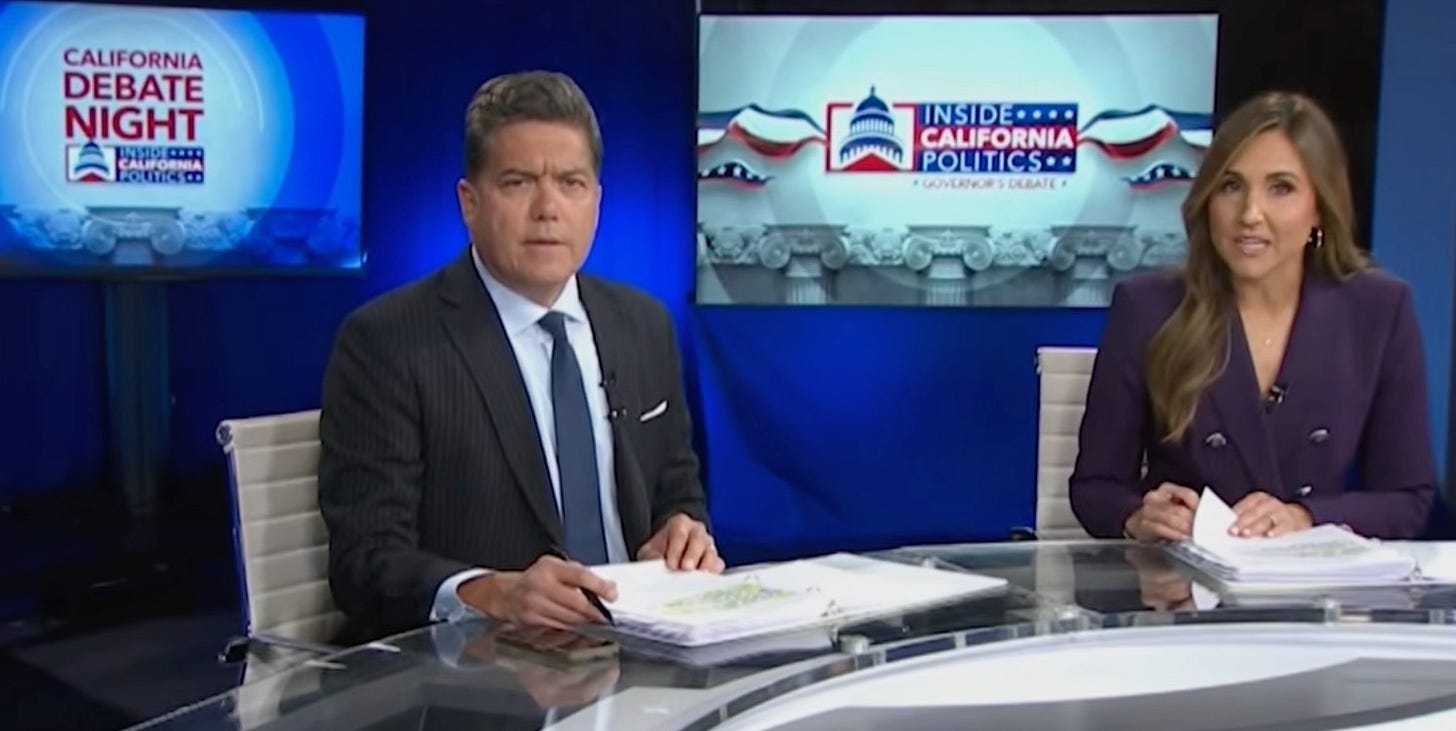
Voters got their first real debate for the California gubernatorial primary Wednesday night. It’s true that there have been many, many candidate forums, town halls and debates over the past months, but this was the first one televised statewide, via Nexstar’s various Golden State channels.
I have watched several gubernatorial candidate forums over the last few months and found this one to be, hands-down, the best executed and most interesting. Perhaps it was the fact that it had a hard, one-hour stop (though the candidates took another 30 minutes of questions for digital audiences), which limited the bluster and kept the answers relatively short.
If you are still undecided about the governor’s race, as I am, it’s worth taking an hour and watching or listening to this debate. Here are my takeaways.
The unexpected winner(s)
I wish I could tell you a clear winner emerged from among the two Republicans and four Democrats. Everyone performed fine. There were no big gaffes or memorable zingers, but no candidate had a standout moment.
To me, the stars of the evening were the two journalists quizzing the candidates — KTXL FOX40 (Sacramento) anchor Nikki Laurenzo and KTLA anchor Frank Buckley. They asked smart, pointed questions, often tailored to the individual positions or experience of the six candidates. They also enforced the time limits and routinely pressed the candidates if they didn’t answer the question, which is a not-uncommon occurrence in debates.

No billionaires tell us what to do, but it still costs money to do this work. So, please consider upgrading to a paid subscription and support independent, home-grown journalism.
The toughest questions
Democrat Matt Mahan, mayor of San Jose, was asked whether voters could trust him to regulate tech when he has so many Silicon Valley billionaires lining up to support him. He didn’t answer directly but said his city has enacted some unspecific tech regulations: “I am not afraid to regulate Big Tech or any other industry.”
Democrat Xavier Becerra, former U.S. Health and Human Services secretary, was asked why, as chair of the House Democratic Caucus when Eric Swalwell was sworn in as a representative from the East Bay, he didn’t act on rumors of sexual misconduct by the former frontrunner in the race who recently resigned from Congress. His answer: “You hear rumors all the time about all sorts of things. Rumors are not facts.”
Republican Chad Bianco, Riverside County sheriff, was asked about his recent seizure of 650,000 ballots from the Proposition 50 election and if he would do the same if he didn’t think the results of the upcoming primary were accurate. When a moderator pressed Bianco after he responded without answering the question, he took affront at the presumption his seizure was based on a feeling and not a legitimate law-enforcement concern: “This is an absolutely ridiculous question.”
Republican Steve Hilton, a former Fox News host, was asked about being endorsed by President Trump and whether the 62% of Californians who disapprove of the job the president is doing are wrong. Hilton didn’t answer the latter part of the question, but said he was proud of the endorsement and would “work with the president” to do things like harvest timber for new homes and fight fraud in government.
Democrat Tom Steyer, a billionaire environmental advocate, was asked about his “tax me more” message and whether he had voluntarily paid more to the government. He didn’t say yes or no, but argued his point was that the system needs to be overhauled: “Me paying more taxes is not the answer.”
Democrat Katie Porter, former congressmember from Orange County, was asked about the damaging video released in October showing her yelling at a staffer during an online interview in 2021. Porter said she apologized to the staffer that very day and continued to work with her for the next four years, which showed she took responsibility for her actions.
 Paul Thornton
My broad observations on each candidate, in no particular order
Hilton: Though he still blames Democrats for every ill in the state, he has clearly done his homework about the state government. For example, when asked about bringing down insurance rates, he cited Proposition 103, the law passed in 1988 regulating insurance rates in California.
Becerra: His unexceptional performance gave no clue why his campaign has surged recently. As the only person on stage who has actually served in state government (he was attorney general from 2017 to 2021) he shared surprisingly few details about his policy positions, something Porter called him on.
Porter: Her campaign has been lagging behind other Democrats, and I didn’t see anything that might propel her ahead of the rest. Her main distinction in this debate: She was the candidate who most often needled the other candidates on the stage (see above).
Bianco: His comments seemed tailored to his MAGA base. For example, his answer to just about every question — lowering insurance rates, increasing housing, bringing down prices — was to get rid of regulations. Which ones specifically? All of them.
Mahan: After Swalwell’s downfall, it left an opening for Mahan on the stage. And he held his own. But for some reason, he really wants people to know that San Jose is the third-largest city in the state.
Mariel Garza
The biggest double-take of the night
Hilton maybe wants to ban smartphones for kids under 16? “Kids do not need a smartphone, and we shouldn’t allow it,” he said. I was so surprised that a Republican would want to ban anything, I had to go back later and check the video.
Despite this better-than-average debate, I remain undecided about the governor’s race. Fortunately, there are more televised debates to come before we have to turn in our June 2 ballots, including one scheduled to be held on the Pomona College campus Tuesday and aired and streamed by CBS stations, starting at 5:30 p.m.


