Elmira Muradkhanyan is a journalism and sociology senior at Loyola Marymount University and Golden State's summer 2026 intern.
The FIFA World Cup has brought more than just international soccer to the United States — it has brought people together. This is a cultural moment as much as a sporting one, with videos online showing fans and non-fans alike gathering at public watch parties and taking over city centers and other public spaces.
I went to a couple of public watch parties in Los Angeles to check if this sense of community was as powerful as it seemed online. What I saw was something revolving around much more than which team wins or loses. These are moments of exuberance, fraternity and cultural pride that transcend soccer – and it’s something we badly need now.

Golden State is a reader-supported publication. No billionaires tell us what to do. Help us to stay independent with a tax-deductible donation.
The outdoor watch party at Century City Mall for the June 25 U.S. vs. Turkey match stood out most to me. Bean bags, picnic tables and families waiting for the opening kick surrounded a massive screen in the middle of the mall.
By my count, more than 100 people were gathered in front of the screen. Fans dressed in Turkey's red jerseys shared beers with people in Team USA jerseys. Members of different families mingled and talked about the game. They chatted, laughed and took pictures of their kids' red, white and blue hair bows.
One fan talked with me about his experiences at events around the city to watch different countries face off. He said one thing he noticed every time was how people came out to cheer their teams but also connect with one another.
“Obviously a lot of folks here were rooting for the U.S. today, and even though people didn't necessarily get the outcome we wanted, you can still feel the positive energy,” he said.
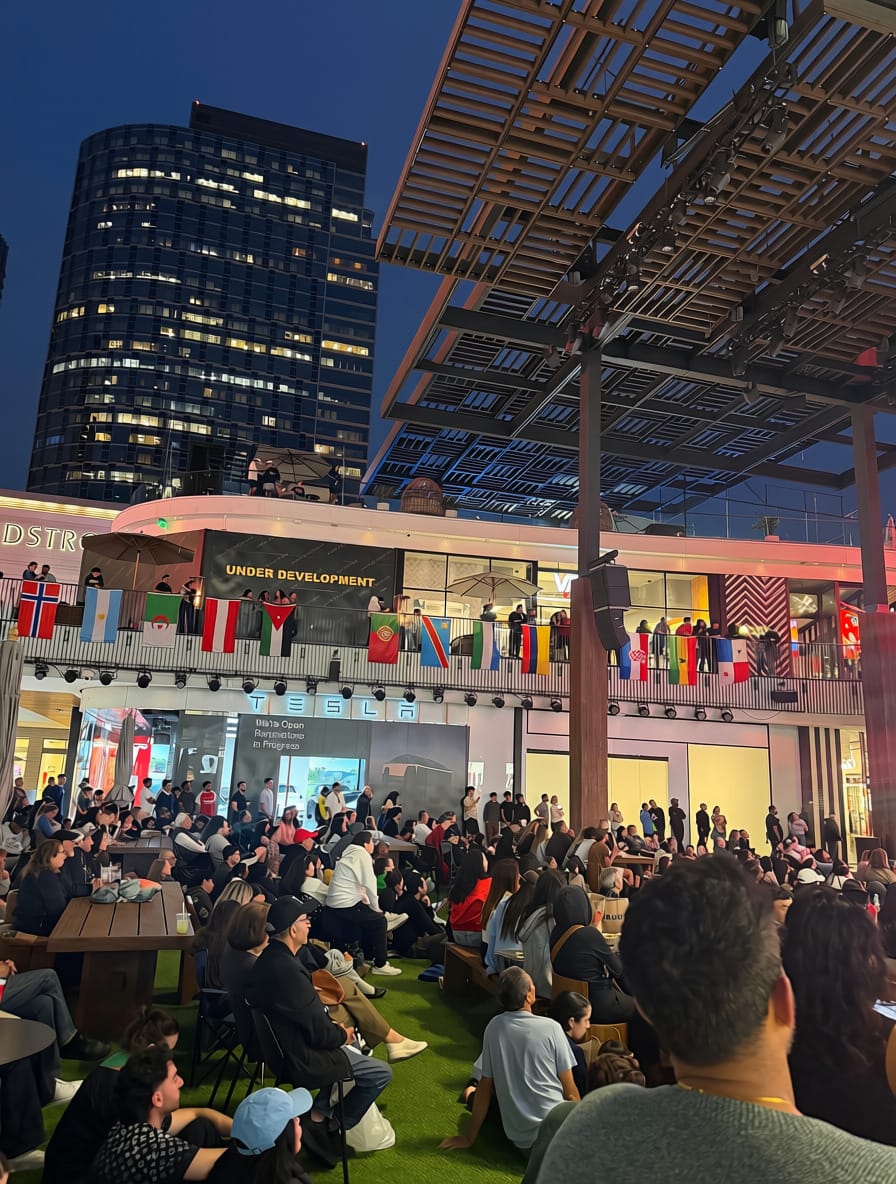
With each near-goal, the crowd would come to a halt, holding their breath with anticipation. Both times Team USA scored, the crowd stood up and cheered. Even passers by in the busy shopping mall would stop and join in.
Some American fans were disappointed when the Turks scored the game-winning goal in the final minute, sealing their 3-2 victory. But few appeared upset. Families stayed long after the last whistle, children remained to play, and conversations continued well into the night.
A man with his partner told me he had come the day before to the mall, saw people gathered at a previous watch party and wanted to join in on the fun. He came the next day to the U.S.-Turkey event with his partner as a fun activity for the both of them, he said.
This enthusiasm might seem strange in a country where soccer hasn’t caught on the way it has around the world. Baseball and basketball draw the best players from around the world to the United States, but professional soccer teams in this country typically get international stars only at the end of their careers, if at all.
 Paul Thornton
But the World Cup is about more than just soccer. It provides a welcome excuse for individuals to slow down and socialize. The competition fosters camaraderie among friends and strangers alike in a world where so much of our interaction takes place through screens.
“I think it's a worldwide thing, everyone needs a little bit of this where everyone comes together,” one fan at the Century City event told me.
The games themselves still matter, of course, but they also serve as a reason for people to get together, whether it's to watch a match with their extended family, host a cookout with friends around the backyard TV or join hundreds of strangers at a public watch party. And the conversations, laughing and memories made while watching the games appear more important than what actually occurs on the field.
Plenty of Americans will probably remain soccer fans after the World Cup ends on July 19. But I think the impact of what people have experienced in real life – the watch parties, the random conversations with strangers about soccer, the public expression of cultural pride – will stick with them long afterward. As the final game of the World Cup approaches, I hope it isn’t also the final moment of people's enjoyment of one another.
 Oscar Garza
 Guest Contributors