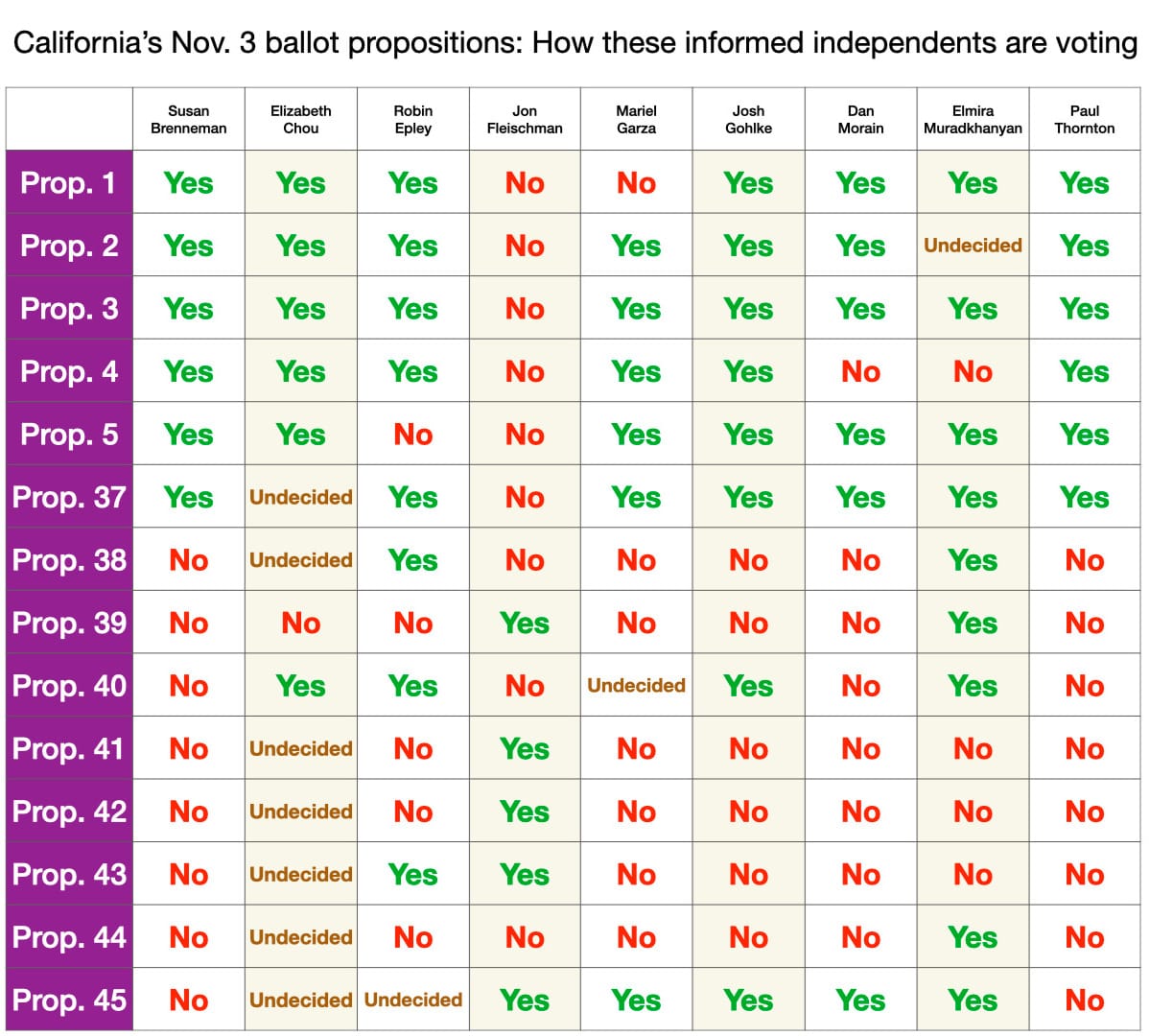
Hundreds of millions of dollars have been spent by political campaigns this election on videos, mailers, texts and emails exhorting California’s voters to support this candidate or that measure. The barrage of spin can be overwhelming, particularly because there are increasingly few sources of informed ballot recommendations from people who have no stake in the outcome.
That's why Golden State staffers and contributors agreed to share their ballot picks for all 14 statewide propositions on the Nov. 3 ballot. These nine independent journalists and commentators are not affiliated with any of the campaigns and have nothing to gain other than what’s best for the state.

Susan Brenneman
Susan Brenneman, contributing editor for Golden State, was the op-ed editor at the Los Angeles Times until August 2025. Previously, she was arts editor of The Times, executive editor of the Los Angeles Times Magazine and the editor of the Sunday magazine at the San Francisco Examiner.
Susan's ballot
California is probably too bond happy. But in this case, the repayment cost is worth it because we need to make housing more affordable.
Volatile times require a larger, more flexible rainy-day fund.
I'm torn but voting yes. I’m for higher taxes on higher incomes, but California should update its tax code, not simply make a temporary tax permanent.
California shouldn't have banned public campaign financing in the first place.
Ousting an elected official requires a majority vote. Replacing one should too.
This deserves an award for most creative use of bonds. Given California's affordability crisis, it deserves a try.
Oh please. Sets a bad funding precedent — a semistealth way to fund its billionaire backer's research institute.
Just. Not. Necessary. Our elections aren't overrun with fraudulent voters. I refuse to use my vote to support a lie.
There are too many downsides to this wealth tax measure to justify the momentary thrill of sticking it to an increasingly heedless billionaire class.
Oh please again. As is pointed out in detail elsewhere in Golden State, this is a shameless, billionaire-funded end run against Prop. 40.
Oh please No. 3. Prop. 42 is another billionaire-funded end run around Prop. 40.
Two-thirds vote is too high a bar for local tax initiatives.
I am persuaded that this is a labor union negotiating ploy and an abuse of the initiative process.
The state reformed the California Environmental Quality Act last year to increase and speed up development. Let's see if that works before we throw the CEQA baby out with the bathwater at the behest of chambers of commerce.

Elizabeth Chou
Elizabeth Chou has been a reporter covering local government in Los Angeles for the L.A. Public Press, the L.A. Daily News, City News Service and other publications. Currently, she publishes the daily "LA Squawk Box" newsletter.
Elizabeth's ballot
I’m leaning toward voting in favor of Prop. 1 because, intriguingly to me at least, the bulk of the funding — $7 billion out of the $11.25 billion — appears to go toward funding the rehabilitation and preservation of existing affordable housing. That's something that doesn’t seem common in a world of "new construction" funding. The bill receives a significant amount of funding from Airbnb, which gives me pause. On balance, though, I'm going to vote yes.
I’ll vote yes to give this a try. If indeed we are struggling with boom-and-bust state budgets, then let's see what happens if we set aside more money for a rainy day. I find the argument that we won’t be getting taxpayer rebates a bit thin.
I'm generally fine with taxing high earners.
Whenever I look up from my usual perch covering local government, I am reminded of how shockingly grotesque campaign contributions are at the state level. Everyone seems so unnecessarily bought, so it feels like the least voters can do is remove some of the corporate-ness out of our state politicians' lives and try to give them a little bit more freedom to become more answerable to the little guys. Also, I feel an underappreciated thing about public funding is that it might make elections more competitive and substantive, as I believe it removes some of the laurels-resting tendencies that can set in for many of our politicians when they need to be taking on tough issues and solving our collective problems in a real, substantive way.
I plan to vote in favor of this. This seems like a straightforward fix of an inconsistency in the recall process.
I'm voting against this because I'm allergic to moves like this to hamper our ability to vote. So, it's a heck no on Proposition 39.
Whenever I listen to a rich person speak, I sometimes start to wonder if they might not be so right in the head. I don't think they need to get therapy. They just need to put down those big bucks, back away and enjoy the small, important things in life that money can't buy — the way the rest of us tend to do. I apologize for being so judgmental. And anyway, I don't think it would really hurt much to take this opportunity to stick it to the billionaires. I can't imagine they'd feel more than a small insect-like poke anyway.

Robin Epley
Robin Epley was until recently an opinion columnist and editorial board member at the Sacramento Bee. Previously, she was a reporter for the Chico Enterprise-Record, where along with the staff she was a 2019 Pulitzer Prize finalist for coverage of the Camp fire.
Robin's ballot
California needs 2.5 million more homes by 2030, and these bonds would put us on the way toward achieving that goal, while simultaneously helping homeless Californians get off the streets. This is an easy yes vote.
I'm sort of split on Prop. 2, but I lean further toward a yes vote. Why? Because more rainy-day funds for the state in the middle of a federal drought sounds like a wise idea.
Obviously a yes. The tax is already in effect; there's not a single good reason why we should end it now.
Prop. 4 doesn't set up a public financing system, it simply allows for such systems to be built if people want them. California's charter cities already allow for public campaign financing, and it's a system that's worked well in other states. Why not expand the option to the rest of California?
Shock and surprise: I actually am leaning no on Prop. 5, if only because elections typically cost taxpayers millions of dollars. It seems like a poor financial decision to split up an election up between the decision to recall and the vote to replace. We don't need to overly complicate this; we can just get it done in one.
Homeownership is out of reach for too many people in my generation. If the state doesn't step in to help out first-time homebuyers, California will become even more unaffordable for us. I'm a strong yes on this bond proposition, which wouldn't take a dime out of taxpayers' wallets, and would help young Californians stay in the state we love.
I want my taxes to go to things like schools, infrastructure, social services and research. In fact, that's what I expect my taxes to go toward. Prop. 38 is an easy yes vote for me.
I cannot express strongly enough how much I despise this attempt to disenfranchise voters. If you know anything about American history or care at all about maintaining the right to vote, you'll vote no on Prop. 39.
Vote yes on Prop. 40, because to those whom much is given, much is expected. Billionaires don't make money from their work, they make their money simply from having money. Taxing them one time at 5 percent so that the poorest among us can have access to healthcare isn't going to stop them from making millions upon millions on their already obscene hoard of wealth. I also don't buy the argument that it's a slippery slope for such proposals in the future. Gov. Gavin Newsom and his billionaire buddies seem to think voters are stupid.
Prop. 41 is nothing but a sneaky attempt to nullify Prop. 40, should it pass. But even if you're voting no on Prop. 40, vote no on Prop. 41 too. Don't hand billionaires another tax loophole.
Like Prop. 41, Prop. 42 is another sneaky ballot measure inserted by opponents of Prop. 40 to try and block a wealth tax from having any real effect. Vote no on Prop. 42 and don't let the billionaires backing this proposition pull the wool over your eyes.
Prop. 43's two-thirds requirement for new taxes is already applied to any new taxes proposed by local governments. Let's make it even across the board, and apply the threshold to all new tax proposals, regardless of where they come from.
I'm a strong no on Prop. 44, because forcing medical clinics to spend 90 percent of funding on "patient services" may sound good in theory but will be chaos in practice. I also think proponents' arguments that hospital administrators are making too much is a red herring; the real issue is going to be keeping health clinics open in rural areas, and financially penalizing them for overshooting an arbitrary threshold isn't going to help. Applying a harsh 90 percent across the board is an unreasonable requirement, and I also don't understand why the state attorney general would be the final arbiter of what counts as "patient services."
The only proposition this year that I'm still undecided on is Prop. 45, as I can commiserate with the arguments on both sides. CEQA absolutely needs reform, but is speeding up the process the right way to do that? I think communities have a right to block projects that are provably bad for the environment. Then again, the whole building process shouldn't be stalled for years over a single, fixable problem. I guess I ultimately lean yes, because it will help housing to be built faster — but this is a tough choice.

Jon Fleischman
Jon Fleischman publishes the California politics newsletter "So, Does It Matter?" and was previously the founder and publisher of FlashReport, a conservative commentary site. He is a political strategist and former executive director of the California Republican Party.
Jon's ballot
Only a small fraction of this $11.25 billion housing bond goes to veterans, while taxpayers repay the borrowing with interest. California's housing problem is a shortage of homes, and subsidizing buyers without increasing supply does nothing to solve it.
A larger rainy-day fund sounds responsible, but Prop. 2 also weakens existing limits on state spending. California needs greater fiscal discipline, not another mechanism that ultimately makes it easier for politicians to spend more.
Californians were originally promised this higher income tax rate would be temporary; Prop. 3 would make it permanent. With California already imposing one of the nation's highest top income tax rates, making it permanent gives successful taxpayers and businesses another reason to leave.
Prop. 4 would repeal California's prohibition on taxpayer-financed political campaigns and allow state and local governments to create them. Citizens should be free to support the candidates they choose, not forced to subsidize candidates they oppose.
Prop. 5 would eliminate voters' ability to choose a replacement when they recall a statewide official. If Californians remove someone from office, voters — not the remaining political establishment — should decide who takes that person's place.
Prop. 37 would borrow $25 billion to subsidize down payments and mortgages, putting taxpayers behind the financial risk. Giving selected buyers more purchasing power does not create more housing — it simply puts more money in pursuit of the same limited supply.
The billionaire funding Prop. 38 wrote the initiative so that nearly half of its $8.4 billion in taxpayer-funded bonds would go to the foundation he chose. Californians should not borrow billions — and pay interest on it for decades — to fund a program designed by its chief financial backer to steer billions to his preferred organization.
Prop. 39 would require government-issued identification and citizenship verification for voting. Requiring voters to establish that they are eligible and that they are who they claim to be is a basic safeguard for election integrity.
Prop. 40 creates a supposedly one-time wealth tax whose rate, threshold and duration could later be changed by the Legislature. It also risks driving wealthy taxpayers — and their future income-tax payments, investment and business activity — out of California.
Prop. 41 would keep revenue from new special taxes subject to California's spending limits and strengthen auditing requirements. Calling a tax "special" should not become a loophole for avoiding fiscal restraints and accountability.
Prop. 42 would prohibit new state personal-property taxes and restrict retroactive taxation. Government should not be able to change tax rules after financial decisions have already been made and then impose a new liability retroactively.
Prop. 43 would restore the two-thirds vote requirement for local special taxes, regardless of whether politicians or a citizens' initiative puts the tax on the ballot. Special interests should not be able to use the initiative process to get around Proposition 13's taxpayer protections.
Prop. 44 would impose a rigid 90-percent spending mandate on nonprofit community health clinics that could squeeze spending on equipment, technology, outreach and other needs. The measure was sponsored by SEIU-UHW and, in my view, uses the ballot box to increase union leverage over healthcare employers.
Prop. 45 would streamline environmental review and reduce opportunities to use CEQA to delay housing, infrastructure and other projects. California's housing crisis is fundamentally about inadequate supply, and making it easier to build addresses that problem directly.

Mariel Garza
Mariel Garza is the executive editor and co-founder of Golden State. She has been a reporter and editor for more than 35 years at multiple news organizations, including the Los Angeles Times, where she most recently oversaw the editorial board.
Mariel's ballot
California needs more housing, but not through taking on more bond debt. This will cost the state between $500 million and $600 million annually for 25 years.
Until we fix California's problematic revenue structure that seesaws with the stock market, we need to save more for the downturns. And there will be downturns, possibly soon.
I'm not sure about Proposition 40, the billionaire tax, but I am quite sure I don't want to give billionaires a tax break in 2031. Besides, this tax passed 14 years ago and the rich only got richer since then.
This just lifts a ban the state should have never adopted.
Because the current system is undemocratic.
It would help middle-class homebuyers, and it is structured so that it puts no financial burden on taxpayers.
It would be a giveaway of $4.2 billion in public money to benefit the wealthy philanthropist who put it on the ballot.
Seems like a backdoor way to curb mail ballots, because it would require voters to write sensitive personal details like the last four digits of their Social Security number on the ballot.
This is a tough one, and I'm still shuffling through the many details and arguments.
This proposition was funded by billionaires to hedge their bets against Prop. 40. I resent rich people misusing the citizen-initiative process for their own benefit.
This proposition was also funded by billionaires to hedge their bets against Prop. 40. I resent rich people misusing the citizen-initiative process for their own benefit.
I think supermajority requirements are fundamentally unfair and undemocratic.
This would hurt community health clinics, not help them.
CEQA has been used by NIMBYs to stop housing. It won't stop unless we put time limits on the review process.

Josh Gohlke
Josh Gohlke is an independent opinion journalist who writes at his Substack, "Laughing Leads to Crying." He was a deputy op-ed editor at the Los Angeles Times and an opinion editor at the Sacramento Bee, the San Francisco Chronicle and the Philadelphia Inquirer.
Josh's ballot
This is an easy one. While public funding isn't the main answer to the state's housing crisis, it can help some of the most vulnerable people and prevent more homelessness.
It makes sense to give our elected officials more flexibility to manage the state's finances. Saddling them with rigid, byzantine tax and spending limits might have felt good, but it hasn't done any good.
California has to tax high incomes to make up for its inability to tax the vast wealth tied up in property values. This is hardly a tragedy given the huge federal gifts these taxpayers have enjoyed.
Public financing may be one of the few remaining ways out of the mess that virtually unfettered political spending has made. It's insane that the state prohibits cities from trying it.
California's flawed recall-and-replace elections have been exploited for too long. This is a sensible and relatively simple reform that addresses the flaw while preserving the recall.
This is even more peripheral to the housing crisis than public funding, but it could help middle-class homeowners and boost supply incrementally without affecting taxpayers.
This is a terrible idea, tailored to disproportionately benefit a single field, a single institute and a single billionaire, dressed up to appeal to people with terrible diseases and those who care about them.
This is yet another retread of an age-old voter suppression tactic disguised as addressing election "security" problems that don't exist. It's hard to believe we have to vote on this garbage.
A modest tax on a tiny group of obscenely wealthy people to shore up underfunded social services: What's not to like?
California has already shown that convoluted taxing and spending rules such as these are no way to run a state. And this proposition is really just a dodgy attempt to defeat Prop. 40 if the voters don't.
See above: This is another tortured taxation rule designed to kill the billionaire tax in case the voters pass it.
Local governments in the state already have limited funding options, and there's no rationale for requiring a supermajority for taxation rather than the simple majority democracies require for most decisions.
The latest in a long series of attempts at labor negotiations via the ballot, this would micromanage healthcare providers' budgets through public policy. It doesn't deserve to be taken seriously.
Despite some recent, overdue reforms to CEQA, which is used to stop building in all kinds of ways that have nothing to do with the environment, California is an incredibly sclerotic, expensive and shrinking state. Reining in the law and speeding needed development of housing and infrastructure will help more than hurt.
Dan Morain
Dan Morain has been a journalist in California for more than 40 years, including as a reporter at the Los Angeles Times, editorial page editor at the Sacramento Bee and senior editor at CalMatters. He is the author of the 2021 book, "Kamala's Way: An American Life," and has new book about the mental health system coming out in April.
Dan's ballot
My default on ballot measures is to vote no — except when it comes to bond measures placed on the ballot by the Legislature. California needs housing, especially for people of limited means. This will help.
The state budget remains volatile. Increasing the size of the rainy-day fund will let the state better manage the ebb and flow of tax revenue.
This is not an easy vote. I covered the debate in 2012 when Jerry Brown promised this tax would be temporary. I wish California would overhaul its tax structure. But this measure will continue an extra tax on high earners, who can most afford to pay taxes, and helps fund public schools, which are important. Count me as a reluctant yes vote.
I don't want my tax money supporting candidates I would never vote for. This measure will do nothing to cap spending by wealthy interests and individuals on independent campaigns for or against candidates.
Voters should retain the right to recall elected officials, but recalls are serious and should not be done lightly. This measure will make it somewhat more difficult to recall officials who cross voters.
Although my default is to vote no on ballot measures, this one seems like a good solution to help first-time home buyers. I have read it and while I am certainly not a lawyer, it seems straightforward.
I wish I could vote for this measure. I support science and believe California has the wherewithal to fund serious research. But this measure is lopsided and would help one institute. It also has an exemption from the Fair Political Practices Act, which would limit public disclosure of its operation. The proponents of this measure ought to go to the Legislature, which would more fully vet it. If it makes sense, legislators and the next governor could place a bond on the ballot to fund this sort of research.
I often judge initiatives based on who funds them. The main funder of the "Yes on 39" campaign is a conservative billionaire who lives in Illinois. Why would he care about California elections? While the measure sounds good, it has vague language that looks to me as if it could be an invitation for litigation that could limit the right to vote. I don't buy the lie that there is voter fraud. People who want to break the law rob banks. They don't risk imprisonment by voting when they're not eligible.
This is a very loaded initiative intended to benefit one segment of union workers. I don't usually side with billionaires, but they can easily move out of the state. Once gone, they would not pay this tax or the extra income tax on high earners I support in Prop. 3. Prop. 40 is terrible policy. California needs to overhaul its tax system, figure out a way to tax services, lower the sales tax rate and lower the income tax rate. But that effort would entail hard work by very smart people — not one union looking for a way to boost its members. Perhaps the next governor will get serious about an overhaul of California's twisted and antiquated tax system. It's a issue worth taking on, Mr. Becerra.
This is a loaded initiative pushed by a billionaire who no longer lives in California. I'm all for audits and open government. But this measure is a classic example of false promises.
I am skeptical of "wealth" taxes. But this measure would rule out future taxes that might make sense. Tax policy is complicated and should not be written by wealthy people seeking special benefits. Again, we need a 21st-century tax system. We need an overhaul, not some poll-tested bombshell of an initiative.
A simple majority vote should suffice for local tax measures. I might support a 55-percent margin for passage. But a two-thirds vote allows a small minority to dictate important decisions to the majority on local needs.
This is an easy no vote. It's proposed by one union that is seeking more clout in its organizing effort. It would add to pressure on health clinics and potentially force them to close at a time when the Trump administration is curtailing healthcare for poor people.
Although my default is to vote no on ballot measures, I part ways with environmentalist groups on this one. I do think we need to make it easier — and potentially a little less costly — to build in California, especially in cities and suburbs. Too often environmental laws are used as leverage, not for the protection of the environment.

Elmira Muradkhanyan
Elmira Muradkhanyan was Golden State's summer intern in 2026. She is a senior majoring in sociology and journalism at Loyola Marymount University, where she is a contributor to the student news outlet The Lion.
Elmira's ballot
I think California needs more affordable housing and better assistance for those who are struggling with the high cost of living. Investing in housing helps alleviate the homelessness epidemic that affects communities around the state and assists more families in finding secure homes.
Although increasing the rainy-day fund could help California get ready for future financial crises, I'm not sure the funds would be handled wisely. I'm particularly worried about whether the state will really use these monies to assist those who are having trouble paying for insurance-related expenses and debt.
I support Prop. 3 because I think those with substantially higher incomes can make larger contributions to support vital services like healthcare and education. Programs that many California families and students depend on could continue to get financing if this tax is kept in place.
I disagree with Prop. 4 because I think that people who willingly choose to support a specific candidate should still be the source of campaign funding. Instead of using public monies to support political campaigns that people may not personally favor, I would prefer to maintain the current system.
I support Prop. 5 because I think the people should have the last word in choosing their representatives. Voters should have a fair and direct say in recall elections, which should represent the people's preferences.
Buying a home has become increasingly difficult for many middle-class families due to high housing costs. Providing loans to eligible homebuyers could give more people the opportunity to afford a home and build financial stability for their future.
I agree with Prop. 38 because I believe funding medical research is important for discovering new treatments, medicines and possible cures for serious diseases. Without enough dedicated funding for research, there may not be sufficient resources to support important medical discoveries that could improve and save lives.
I believe requiring identification when voting could give an extra safeguard against voter fraud and enhance confidence in elections. It's a fair way to confirm a voter's identity and ensure that all valid votes are counted correctly.
I wholeheartedly support Prop. 40 because I think billionaires ought to contribute more when their funds may be used to support vital services that Californians depend on. Since healthcare and education are vital resources that need to be available and adequately funded for everyone, I am particularly in favor of spending the proceeds for these purposes.
I worry that adding more requirements and audits could make it harder for new tax programs to provide funding where it is needed. I would rather see money go directly toward important programs, such as healthcare and education, instead of creating additional barriers that could limit that funding.
I disagree with Prop. 42 because I think California should still be able to tax extremely wealthy people when the money raised may be used for crucial public services. This proposal shouldn't stop policies like a billionaire wealth tax from increasing financing for things like healthcare and education.
A simple majority should be enough for voters to approve a local tax measure that citizens themselves put on the ballot. Requiring two-thirds support could make it much harder for communities to raise funding for services and programs that a majority of voters support.
I believe community health clinics should have the resources to provide better care and more opportunities for people who cannot afford healthcare or health insurance. Increasing support for these clinics could help make essential medical services more accessible to people who need them most.
We need to speed up environmental reviews could help California complete important projects like housing, schools and road improvements more efficiently. These are resources that many communities desperately need, and reducing unnecessary delays could help provide them sooner.

Paul Thornton
Paul Thornton is the managing editor and co-founder of Golden State. Previously, he worked for 19 years at the Los Angeles Times' Opinion section as an editor, writer, web producer and researcher.
Paul's ballot
California needs more housing, and its affordable housing program funds need replenishing.
California's tax-revenue volatility demands a larger rainy-day fund to stabilize funding for needed programs and services.
The tax enacted by Prop. 30 was sold as temporary, but school districts across the state are falling off a fiscal cliff. They really need the money.
Not even giving the state and most California cities the option of public campaign financing makes little sense to me in era of dark money and extreme wealth concentration.
It doesn't make sense to me that a recalled official's replacement can "win" with fewer votes than the number of people who voted against the recall.
Housing is so unaffordable in California that it makes sense to expand the pool of buyers eligible for down payment assistance.
The measure is deceptively written in a way that will almost certainly fund the immunology research institute of its billionaire backer. The competitive grant process it creates betrays long-held standards of scientific openness.
Ballot fraud is such a minuscule problem that any proposal to put up more barriers to voting has to clear a very, very high bar for me.
My gut tells me yes, but my brain says no. Backfilling longterm cuts with a temporary wealth tax seems like bad policy.
I don't appreciate this sneaky effort to undermine Prop. 40.
A second Prop. 40 poison pill? Sergey Brin has too much money. And banning future taxes that might one day make sense for California is a bad idea.
Two-thirds supermajority requirements are, in my view, inherently undemocratic.
The union sponsoring Prop. 44 has tried to organize workers at the clinics this measure targets. Playing hardball against billionaires with Prop. 40 is one thing, but safety-net clinics? Really?
California needs CEQA reform, so initially I supported Prop. 45. But I did a fair amount of research and found this could have far-reaching unintended consequences that would be extremely difficult for future Legislatures to fix because this is a ballot measure.