Darrell Kunitomi had a 47-year career at the Los Angeles Times giving tours and speaking to outside groups and schools. He retired as the newspaper’s historian and lives in Echo Park.
An image from the Rose Parade is burned in my memory: It’s the mid-1960s, and my mom, Masa Kunitomi, is the first of our seated family to rise as the Marine color guard approaches. Mom's hand is over her heart, and her eyes shine as she looks up Colorado Boulevard. She loved this country so much.
Two decades before, she was held behind barbed wire in Wyoming by that same country. After the bombing of Pearl Harbor in 1941, about 120,000 “Japs” became the hated, back-stabbing enemy, poised to destroy America, sneak into its defense industries and strike their neighbors as they slept.
It did not matter that two-thirds of the imprisoned were native-born U.S. citizens. My mother was an American girl who went to Hollywood High. She did not bomb Pearl Harbor. She was not the “worst of the worst.”

Golden State is a member-supported publication. No billionaires tell us what to do. If you enjoy what you're reading, please consider upgrading to a paid subscription and support independent, home-grown journalism.
The Japanese in the U.S. in 1942 were swept up by the unfortunate hate and fear that seeps out of American skin when the heat is on.
And the heat is on again. Today it comes not from war but straight from the president himself and the anti-immigrant bias of the people around him. I see men and women getting chased by ICE agents at car washes, stores and taco stands. They don’t look like dangerous criminals and drug dealers to me.
Government incarceration camps are back, filled with people abducted from their neighborhoods and sent to distant, unfamiliar parts of the country, as my family was in 1942. Back then, the camps had visitors, classes, sports teams, music performances, gardening and even photos of their interiors (approved by the government, yes, but sometimes taken by the estimable Ansel Adams and Dorothea Lange). But make no mistake, the camps were not benign: Seven men were gunned down by guards during World War II-era “relocation,” and many more were injured. The imprisonment of 120,000 people is rightly understood as one of the worst violations of constitutional rights in history.
 Paul Thornton
Today’s camps are black holes. Ghastly reports trickle out – of detention center staff in Montana betting on which inmates will try to kill themselves first, of 911 calls from desperately sick detainees in Texas. People go in, get transported and sometimes disappear. We know some have died in custody.
My mother loved her country despite what it did to her. I have no doubt she would be horrified by what’s happening today.
I've thought a lot about Japanese American patriotism over the years. Recently I gave a talk in San Francisco about my hero uncle, Army Pfc. Ted Fujioka of the 442nd “Go For Broke” boys. Uncle Ted was the embodiment of raw 1940s patriotism: He was a prisoner at the Heart Mountain Relocation Center in Wyoming when he decided to volunteer for service at age 18.
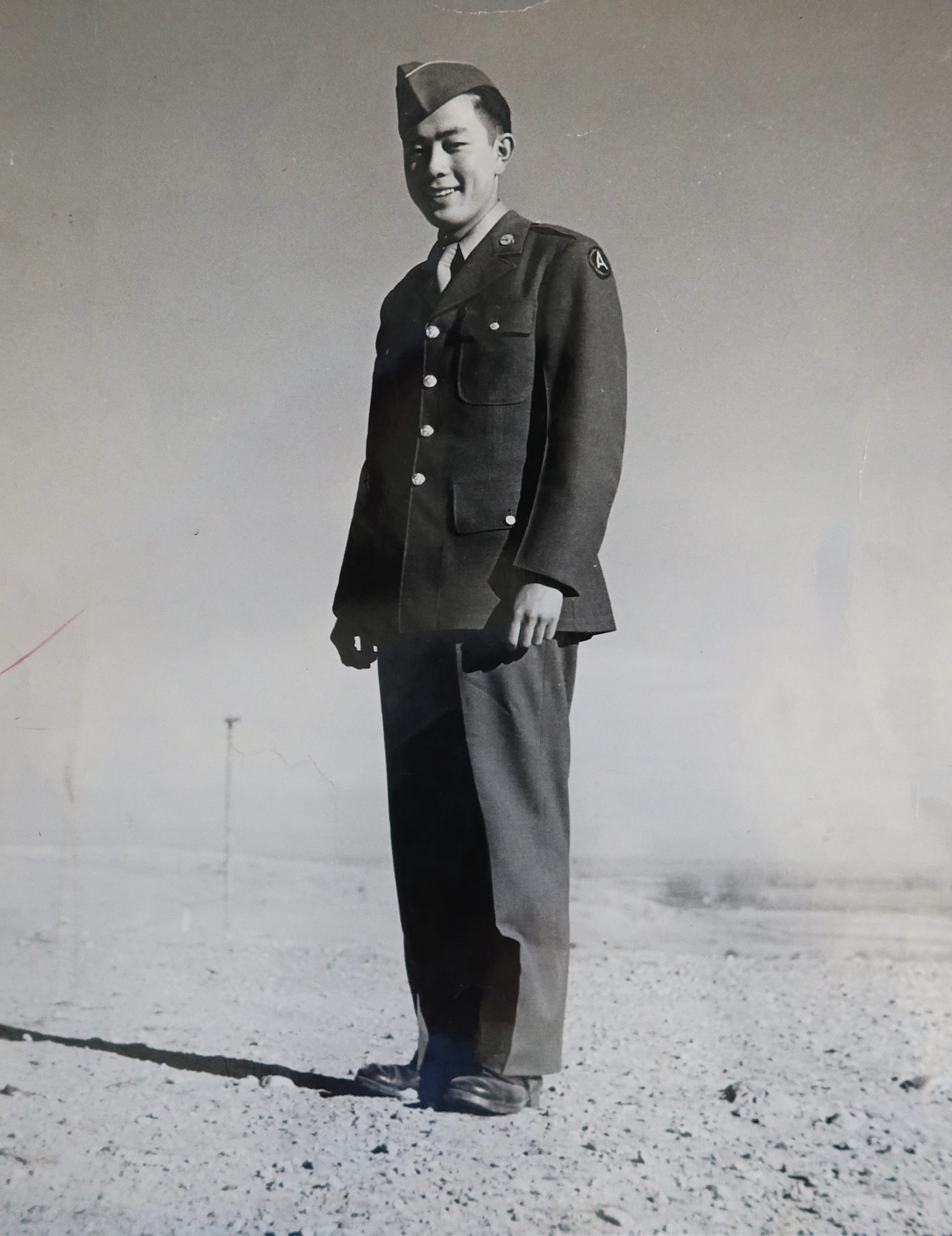
He wrote about his feelings in letters back to his incarcerated family: "I'm fighting for my family's place in the America to come. For my children, the Sansei." (That’s my generation.) In a letter published in the camp newsletter, the Heart Mountain Sentinel, on Sept. 4, 1943, he wrote:
“One young, intelligent fellow about my age, a Negro, taught me the most. His thoughts, ideas, hopes and goals, why he volunteered, his thoughts on race prejudice, and inequality ran parallel to mine…. We must work for not only ourselves, but for all other minorities as well, for if we don’t we can never hope to make this country the melting pot of the world.”
The young soldier who wrote those words fought for an America he never got to see. He was 19 when he was killed in action in France in 1944.
The service and sacrifice of soldiers like Uncle Ted did much to ease the post-war hate for Japanese Americans. But it didn’t erase it.
 Mariel Garza
Right around the time my mom saw the Marines in the Rose Parade in the mid-1960s, I had a run-in at the El Sereno Recreation Center. This was during my generation’s wonder years in Los Angeles, back when the city was less crowded and Boomer boys like me roamed the hills, shot BB guns and built forts in vacant lots.
I was playing caroms when a white boy my age walked up. I made the challenge: Hey kid, wanna play? That kid was good, actually excellent – he ran the table on me. But it wasn’t the losing that stung: With every shot he announced, “This is for what you did to our boys at Pearl Harbor,” and, “This for what you did to our boys at Iwo Jima,” and so on.
I just stood there and took it, like a nice middle-class Japanese American boy. Silently.
Two decades after my Uncle Ted and 33,000 other Japanese Americans fought for the U.S. – and even as it was becoming clear how much of an injustice the so-called relocation camps were – old prejudices remained. Today, the Trump administration insists it is rounding up the “worst of the worst,” seizing on old unfounded fears of mass crime and fraud by immigrants.
 Josh Gohlke
Masa Kunitomi died of cancer in 1985. I'm glad she didn’t live to see how far America has retreated, again, from the country she loved. She was a teacher and she surely wouldn’t have tolerated her students and their families being forced into camps as she was. She would consider it her duty to oppose ICE and the shootings of Americans in the streets by federal agents.
But she and Uncle Ted are long gone. This is my country now, and I love it as so many patriotic Japanese Americans do, with an asterisk. It is still the America my Uncle Ted wrote about in his letters to Heart Mountain: a place where minorities are targeted, a place where we must fight for a better day.
 Mariel Garza
 David L. Ulin