

Joel Bellman, a former editorial and op-ed writer at the Los Angeles Herald-Examiner and an award-winning radio editorial and documentary producer, served for 26 years as press deputy to three Los Angeles County Supervisors.
For more than five years, Donald Trump has falsely blamed mail-ballot “election fraud” for his 2020 defeat by Joe Biden. He used that lie to incite an insurrection before leaving office in 2021, and to pardon and even financially reward the criminals who took part in it after he returned to the presidency last year.
And now it’s the lie behind Executive Order 14399, signed on March 31, demanding changes to mail balloting that could functionally deny the vote to millions of Americans. Thankfully, California provides voters multiple convenient options for casting their ballots, and election officials told me they’re preparing to handle problems that could arise before the Nov. 3 midterm.

Golden State is a reader-supported publication. Help us to stay independent with a tax-deductible donation.
Among other things, the executive order “enables” (i.e. requires) states to help the federal government generate state-specific citizenship lists. Most importantly, it bars the U.S. Postal Service from mailing ballots to individuals not included in the federal citizenship lists, and requires a fresh review and potential redesign of mail-ballot return envelopes before they could be used.
Twenty-three states (including California) plus the District of Columbia challenged the executive order in court, and in June U.S. District Judge Indira Talwani issued an order halting the mail-in ballot and voter list provisions from taking effect before Nov. 3. But on Aug. 24 – less than two weeks before North Carolina starts sending out ballots on Sept. 4 – the U.S. Supreme Court threw state election systems into chaos by pausing Talwani’s injunction on procedural grounds, granting the Trump administration emergency relief and allowing it to begin implementing the executive order.
Talwani has since issued a 14-day temporary restraining order against the postal service’s new mail-in ballot rules. On Monday she denied the administration’s appeal to lift it, writing that the changes demanded in Trump’s executive order “are contrary to the public’s need for ‘clear and settled’ ‘rules of the road’” for midterm elections that are only two months away. The federal government argued that while it’s too close to the election for a 14-day temporary restraining order, it’s somehow not too close for a ballot envelope redesign or restricting mail voting based on potentially error-ridden last-minute citizenship lists.
California’s chief elections official, Secretary of State Shirley Weber, struck a defiant note in an Aug. 24 statement: “At a time when voter confidence is already fragile, the Supreme Court is giving a green light to President Trump's attempts to take over our election system and sow distrust in state elections. This unconstitutional power grab threatens to disenfranchise California voters, and it will not stand.”
 Joel Bellman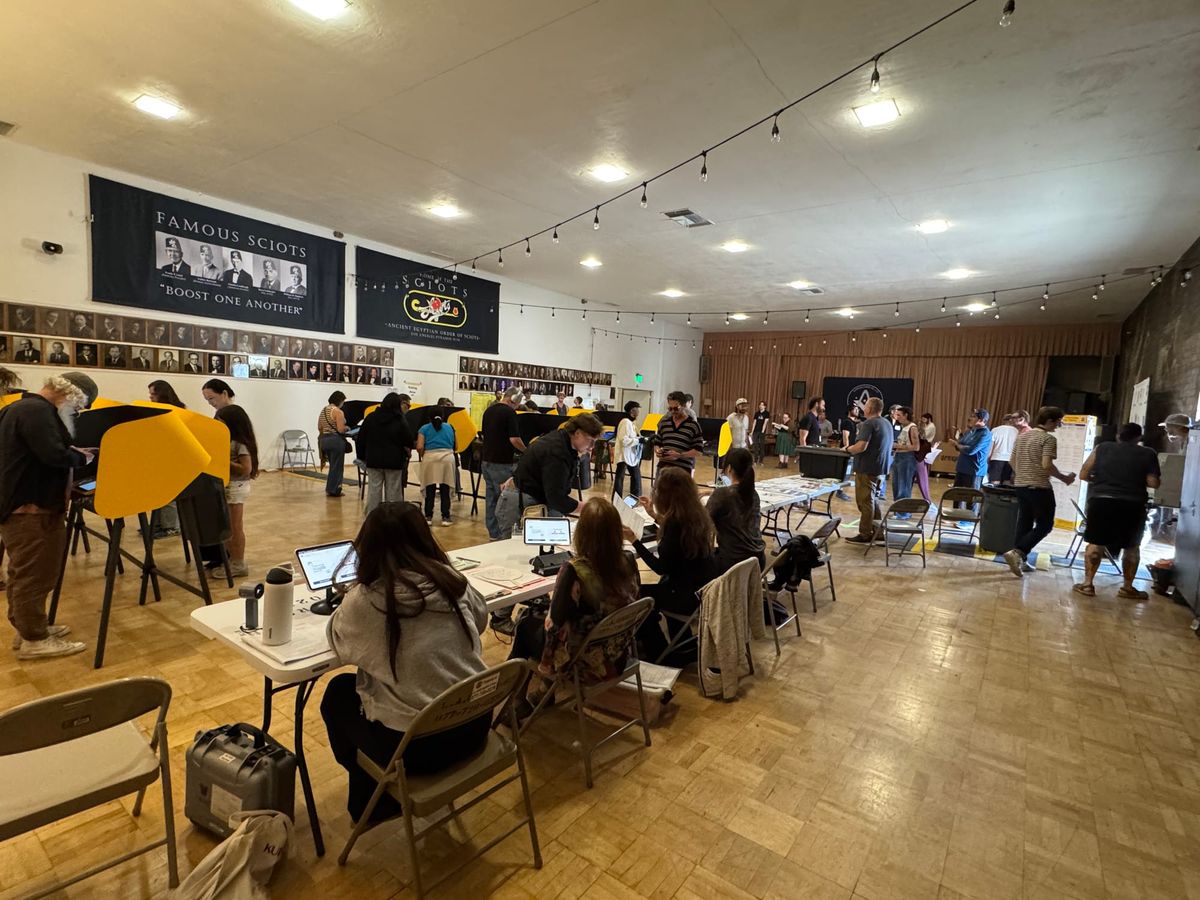
Los Angeles County Registrar-Recorder Dean Logan, a capable administrator who has overseen county elections since his appointment in 2008, has also expressed confidence that the November election will ultimately proceed as normal, but he has been busy developing contingency plans, just in case.
Since the pandemic, California has sent vote-by-mail ballots (what we used to call “absentee ballots”) to all registered voters. In the June 2 primary, 81.8% of all votes in L.A. County were cast with these ballots rather than in person at one of the county’s 646 vote centers. In a worst-case scenario, in which the Trump administration and the courts make it functionally impossible to conduct a normal vote-by-mail election, state and local officials would have to scramble to distribute those ballots outside the normal mail chain.
Moreover, if most or all voters were forced to cast their ballots in person, counties would have to dramatically expand their vote center capacity – increasing the number of centers, keeping them open longer and staffing them with hundreds or even thousands of newly recruited volunteer poll workers.
“It’s obviously concerning that there's even discussion of major changes to the process this close to an election,” Logan told me. “That's just not responsible, and unfortunately, I think the intent and probably the biggest threat of this is really more around causing concern and distrust of voters, and that potentially impacting participation, then the actual tangible effects of it.”
 Paul Thornton
Logan, who doesn’t think the current court battle will “dramatically impact our ability to get ballots in the mail for voters or for voters to return those ballots,” worries about the effect on future elections. But he said there’s built-in resiliency in California’s election process: “Our voting model, different than a lot of places in the country, allows voters multiple options for voting.” These include not only receiving and returning a ballot by mail, but also returning it at a drop box or vote center, as well the traditional way of generating and casting a ballot in person.
Kim Alexander, president and founder of the nonpartisan, nonprofit advocacy group California Voter Foundation, shares Logan’s confidence in California’s multiple voting options: “None of that is changing,” she recently told me. Alexander echoed Weber’s belief that the courts will ultimately strike down the “scheme envisioned by the executive branch to filter mail based on citizenship data.”
Still, the threats are real, Alexander said, “but we cannot let them deter people from voting. That is part of what these initiatives are intended to do – to leave people feeling scared and uncertain.”
California has spent years fostering – often in the face of withering criticism – a culture of voter participation and scrupulously accurate vote-counting. Now, under relentless attack, that culture could be our salvation through the most challenging election in recent memory.
What do you think? Golden State is a public forum. Send responses for possible publication to forum@golden-state.org.


