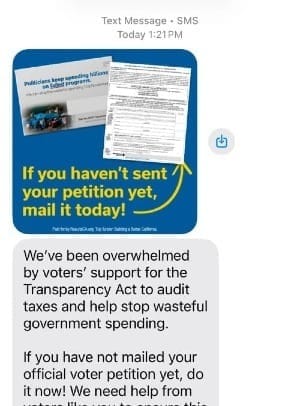
On Saturday, I received a petition in the mail for “The Transparency Act,” a proposed ballot initiative that would require audits for programs funded by new state special taxes.
It was accompanied by a note from the proponents, Californians for a More Transparent and Effective Government, saying that the government had squandered billions of tax dollars on homelessness and other programs, and that signing the petition would help finally end such wasteful spending.
Sounds great! Who isn’t against reckless government spending?
But the proposal and the message set off my BS detector. I have covered enough elections over the decades to recognize fishy campaign come-ons. First, sending petitions to individual voters is not cheap. And who or what was behind that innocuous-sounding group or the committee funding it, Building a Better California?

Golden State is a member-supported publication. No billionaires tell us what to do. If you enjoy what you're reading, please consider upgrading to a paid subscription and support independent, home-grown journalism.
California billionaires, it turns out.
A check with Cal-Access, the state’s public campaign finance database (it’s easy; you can do this too), shows that funders of the proposal are some of the world’s richest people, including Google cofounder Sergey Brin and California agriculture mogul Stewart Resnick.
So … they care so much about government waste that they decided to spend millions of their own fortunes to root it out? I didn’t buy it. Then I found a line, deep in the language of this ostensibly good-government measure, that could nullify another better-known initiative gathering signatures at the moment: the so-called billionaire’s tax, a one-time 5% wealth tax on the richest of the rich in the state.
Aha! Sneaky.
 Mariel Garza
If it’s election season, it’s also election deception season. For the next eight months, California voters will be inundated with calls, texts and mailers from campaigns for the June 2 primary and Nov. 3 general elections that aren’t always straightforward about their intent.
I’m not the only journalist who made the connection between the direct-mail petition and the wealthy people behind it. Journalists are the first, and often only, defense against misleading and mendacious messages. But recent cuts at the state’s largest newspaper, the Los Angeles Times, means there are fewer people doing this important work.
One of the most significant losses is the L.A. Times editorial board, of which I was a member during the last election season. For the first time in modern history, there is no active board of seasoned journalists to keep tabs on shady campaign tactics or issue election endorsements, which was one of the most important services the Times provided to readers.
I know this because, in election years, our endorsements were the largest drivers of reader traffic and new subscriptions — and for good reason. The Times editorial writers spent months vetting candidates and ballot measures: We grilled office seekers, scoured their records and talked to people about their character. We interviewed supporters and opponents of ballot measures and then talked to independent policy experts and examined data and research. As a group, we discussed our findings before writing carefully argued recommendations.
 David L. Ulin
Golden State was born in part to fill the void. I have served on several editorial boards around California, including the Sacramento Bee and Los Angeles Daily News. And though the tiny Golden State staff doesn’t (yet) have the resources to tackle all the races in 2026, we will be taking on a few crucial contests.
We won’t be doing endorsements, but we will have pointed coverage about the prominent candidates challenging Mayor Karen Bass in Los Angeles and seeking to replace Gov. Gavin Newsom, of course. But we will also research all sides of races that aren’t as high profile but have much at stake for the city and state.
 Mariel Garza
For example: In California’s deeply blue 32nd congressional district, Democratic Rep. Brad Sherman faces stiff primary competition from a handful of Democrats, including Jake Levine, a former Biden White House aide and son of a former L.A. Congressmember Mel Levine. The district includes parts of the Westside and the San Fernando Valley.
And in L.A. City Council District 1, which stretches from Highland Park to Westlake and Koreatown and includes the notoriously squalid MacArthur Park, incumbent Eunisses Hernandez faces four opponents in the June 2 primary. Hernandez won her seat in 2022 with the support of the Democratic Socialists of America, so the outcome will test voters’ receptiveness to progressive leadership in City Hall.
You can help craft our coverage this year. Which Los Angeles or state races need more attention? Is there an Assembly race crowded with unknown candidates that needs close scrutiny? A school board race that’s hard to parse? Please let us know at forum@golden-state.org.
 Paul Thornton
 Jim Newton