

Oscar Garza is director of the Specialized Journalism / Arts & Culture graduate program at the University of Southern California Annenberg School of Journalism. He has been a culture writer and editor at KPCC/LAist, Tu Ciudad magazine and the Los Angeles Times.
Downtown Los Angeles is perhaps the last place you’d expect to see a massive statue honoring Confederate generals Robert E. Lee and Stonewall Jackson. And yet, there it is, dwarfing visitors at MOCA’s Geffen Contemporary warehouse space in Little Tokyo.
The statue is part of “MONUMENTS,” an exhibition of tributes to Confederate heroes that were removed from public view throughout the South in the wake of the Black Lives Matter movement, and protests following the killing of George Floyd and other Black Americans by law enforcement agents. The statues are paired with works by contemporary artists reflecting on the monuments and what they represented in American society. A companion exhibition, Kara Walker’s startling deconstruction of a Stonewall Jackson statue, is on display at The Brick, a gallery in Melrose Hill.
In my 35 years of seeing exhibitions, and writing and editing stories about the visual arts in Los Angeles, “MONUMENTS” is as stunning as any show I’ve ever experienced. The juxtaposition of the Confederate statues with powerful and sometimes eerie contemporary works is sobering and brilliant. Christopher Knight, the esteemed, recently retired Los Angeles Times art critic, called it “the most significant show in an American art museum right now.” The New York Times’ Jason Farago wrote that it’s “the year’s most audacious and contentious new show.”
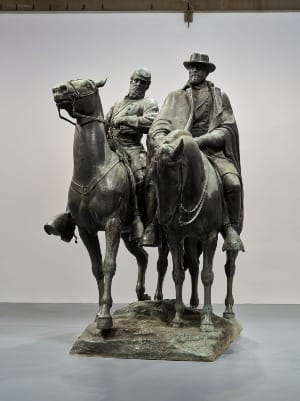
But all due praise aside, the curators passed on a golden opportunity to give the exhibition a special resonance in Los Angeles.
About a 15-minute walk from the Geffen Contemporary is Plaza Olvera, considered the birthplace of Los Angeles. And it was there, in June of 2020, that Indigenous activists took down a statue of Father Junipero Serra – the Franciscan priest who led efforts to convert the native population in Alta California to Catholicism in the late 18th century. As Carolina Miranda reported in the L.A. Times: “This was done by confining them to missions up and down the coast. Natives who tried to escape were captured. Those who disobeyed were beaten. Indigenous beliefs and customs were banned.”
The Serra incident occurred as “MONUMENTS” curators were taking extraordinary measures to secure the Confederate statues and transport them to Los Angeles.
In a recent conversation at The Brick, “MONUMENTS” co-curator Hamza Walker told me that the curatorial team was aware of the Serra statue’s fate. But he said that limited resources kept them from expanding the show. More importantly, they wanted to retain the curatorial focus on the Confederate monuments.
I believe in curators freely executing their vision for an exhibition. And to have this genius show originated in Los Angeles — as opposed to New York or a Southern city such as Atlanta — is quite a coup. (The exhibition will not tour.) And if the "MONUMENTS" curators had included the Serra statue, it’s possible they would have been criticized for making a perfunctory nod to Native American suffering.
But exhibitions, and where they are mounted, shouldn’t exist in a vacuum. Especially in a city and region with its own troubled history. And it’s not as if there aren’t parallels between these histories.
While the Civil War was being fought, secessionists dominated the white population in Southern California. Those sentiments persisted, and in 1925, a Confederate memorial was installed at Hollywood Forever cemetery to honor Confederate soldiers who died and were buried here. The memorial was sponsored by the Confederate Monument Association of Los Angeles and the United Daughters of the Confederacy. Seven years later, the Serra statue was erected downtown.
The Hollywood Forever memorial stood for almost a century; it was removed in 2017, three years before the Serra statue was toppled.
The Confederacy had a presence in Los Angeles. The Spanish conquest still does: Plaza Olvera remains home to a statue honoring the Spanish king, Carlos III, who reigned as his subjects settled L.A., leading to the subjugation of Native people.
The “MONUMENTS” exhibition is a sterling accomplishment. Unfortunately, discomforting monuments still exist here.
"MONUMENTS" remains on display at the Geffen Contemporary and The Brick through May 3.


