Elizabeth Aguilera, an assistant professor of journalism at Loyola Marymount University, has been a reporter at CalMatters, Southern California Public Radio, the San Diego Union-Tribune, the Denver Post and the Orange County Register.
When Donna Marie Bernal fled her home of 40 years the night of the Eaton fire, she didn’t know she was leaving for the last time. She was 4 when her family first rented their house on Mountain View Street in Altadena, and except for a brief childhood stay in Mexico, they never moved again.
A year later, Bernal told me she wishes she could go back; so do numerous renters who lost their homes and their hometown in the fire. But many don’t know if or how they can. As rebuilding discussions mostly focus on homeowners, renters face a different reality: little insurance, limited financial support and an unknown path to return.
It’s jarring to be untethered from your home and town suddenly. I know this feeling well: My family remains displaced by the Eaton fire. Our rental home of eight years survived, but all of our possessions were lost to toxic fire smoke and contaminants.

Golden State is a member-supported publication. No billionaires tell us what to do. If you enjoy what you're reading, please consider upgrading to a paid subscription and support independent, home-grown journalism.
As a journalist, I’ve covered many natural disasters, and renters almost always say they feel left out of discussions about rebuilding and returning. It’s no different with Altadena. If renters remain an afterthought – a startling oversight in a county where 54 percent of all residents are tenants – the Altadena that gets rebuilt will look substantially different than what was lost.
Before the fire, renters accounted for up to 30 percent of the unincorporated town’s population, according to the Altadena Tenant’s Union. Experts say the percentage was likely higher because of multigenerational households and informal arrangements.
A study by the UCLA Latino Policy & Politics Institute underscores how deeply renters were embedded in Altadena. It found that 70 percent of them had lived in Altadena between five and 15 years, while more than 20 percent had lived there for longer than 16 years.
“Folks who are tenants of communities post-fire feel underseen or overlooked,” said Gabriella Carmona, senior research analyst at the institute and co-author of the study. “What’s interesting in Altadena is the population of tenants seemed to have had significant roots in the community before the fire.”
Renters had the same reasons as homeowners to stay: The close-knit community under a vast tree canopy in the foothills above Pasadena – diverse, artsy and a little rural – was an outlier in this metropolis.
 Paul Thornton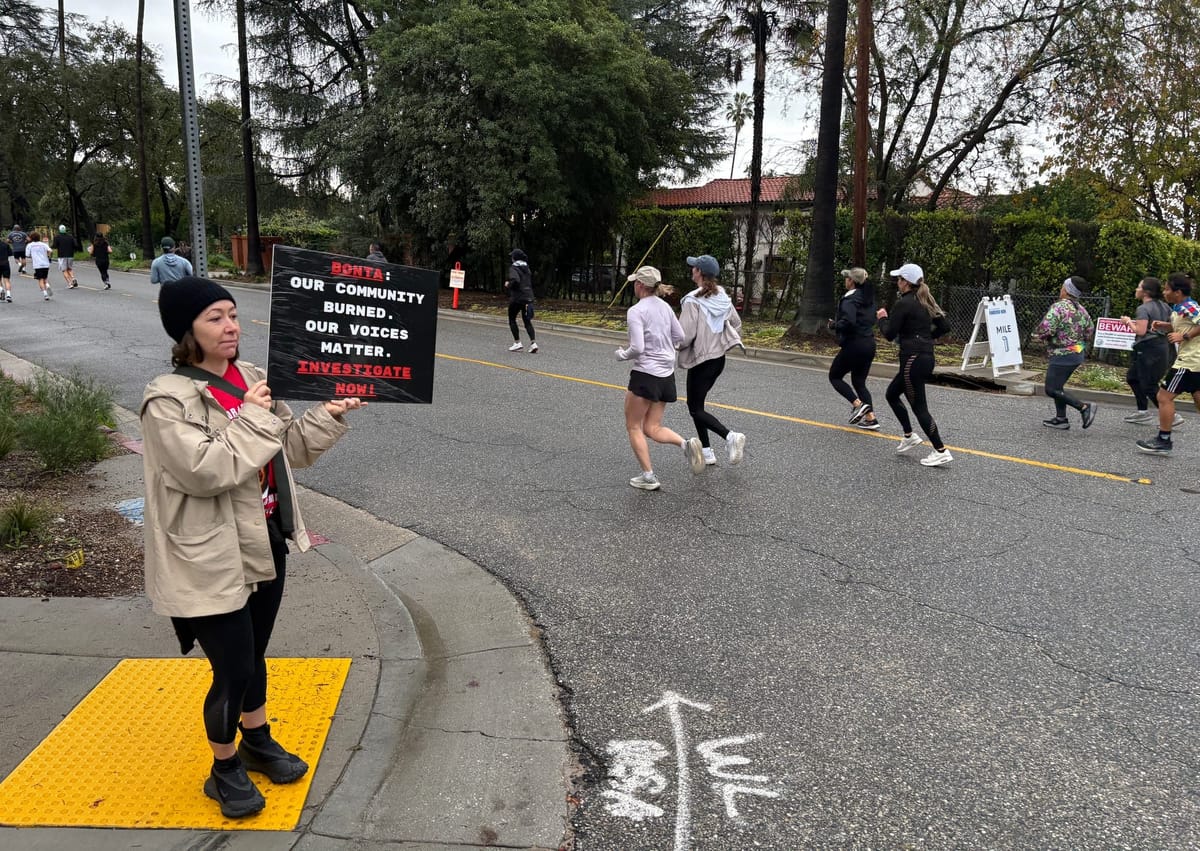
If not Altadena, where?
“The awareness that renters exist is not there,” said Katie Clark, a 16-year resident who co-founded the Altadena Tenants Union. “We exist.”
Clark returned to Altadena the morning after the fire began and watched her apartment building burn. A few weeks later the union was born to advocate for renters.
In a summer survey, the Eaton Fire Housing Collaborative found that 91 percent of Altadena renters were underinsured or not insured at all, and that about three-quarters still needed stable housing.
“Tenants face a significant housing loss without the asset protection that some homeowners have,” Carmona said. “Getting housing, going through remediation, getting their security deposit back — these are all the little pieces that fall through the cracks. Tenants are left at the whim of a landlord who chooses to expedite repairs or exit the market.”
Clark, who paid $1,446 a month for her one-bedroom apartment in Altadena, now pays $2,880 for a place 30 miles east in Pomona. She is determined to return to Altadena, but she still doesn’t know how and when. Bernal landed an apartment in neighboring Pasadena, but is paying $700 more than her Altadena rent. Both cases symbolize the sticker shock over market-rate rent that many longtime tenants faced after years of living in the same housing.
 Mariel Garza
The night of the fire, Bernal evacuated with her mother and fiancé. She grabbed the figure of baby Jesus from the nativity on her way out the door. Her mother, 72-year-old Joanne Castaneda, died five months later from pancreatic cancer.
“I don’t want to go anywhere else. I want to go to Mountain View where I belong. Even my mother’s ashes are going to Mountain View Cemetery,” Bernal said.
Renters face compounding vulnerabilities
A survey of the 2021 Marshall fire survivors, in Boulder, Colo., found renters were more likely than homeowners to leave the city and had low participation rates in post-fire decision-making. A 2023 Brookings report found that in the previous fiscal year, renters received about 22 cents for every $1 given to homeowners by the Federal Emergency Management Agency’s Individual Assistance program.
The UCLA research highlights compounding vulnerabilities. Renters are more likely to be lower income and spend a higher share of their budgets on housing.
In Altadena, renters displaced by smoke and toxic damage lost their belongings, and many are in a kind of purgatory, waiting for landlords to make their units safe for habitation. Others moved back to ash-filled homes under pressure to pay rent and do the clean up themselves. And others just left altogether.
A new law authored by state Sen. Sasha Renée Pérez (D-Pasadena) and supported by the tenant’s union clarifies that landlords are responsible for repairing and remediating rental units after a disaster and that tenants don’t have to pay rent during mandatory evacuations. However, that law applies to future disasters; it does not help renters affected by the Eaton fire.
What do you think? Golden State is a public forum. Send us your responses for possible publication in the future.
Other than clothing, food and mattress giveaways, financial assistance has largely bypassed renters. A new L.A. County program provides payments to landlords, prioritizing those with four or fewer units, if they have fire-survivor tenants facing eviction because they are behind on rent. Tenants cannot apply.
“It’s not rent relief; it goes to landlords,” said Benjamin James, whose family lost their rental home of five years in Altadena and now pays $1,000 more a month for a place in Van Nuys.
“Property owners have hope they are going to get a shadow of a life back,” he said. “But renters don’t have that. We are never going to have that. It’s over and it’s done.”
On that fateful night, James took his two kids to a hotel because of fierce winds. His wife was away. Their cat, Elliot, stayed home.
The family has struggled since the fire. New schools, too many moves, more expensive housing, leaving their friends and losing their orange tabby cat have changed his family, James said. They plan to leave California next year.
 Lisa Kaas Boyle
Had he been able to rescue Elliot, he believes, things would be different.
“It is the biggest regret of the whole thing,” he said through tears. “I feel like if he would have gotten out, we all wouldn’t be as hurt as we are.”
Recently, the family adopted an Australian shepherd puppy. Her name is Dena.
I bet lots of pets adopted after the fire will be named Dena. Altadena was a special place. It will come back, but it won’t be the same.
As for my family, we lost much more than our material possessions. We lost the safe place where we first took our babies home and the foothill community that finally made my Colorado-born husband feel he could stay in Los Angeles.
On Jan. 7, the anniversary of the Eaton fire, we visited our favorite pizza spot in Altadena. For a moment, it felt like our family was home. We hope our fellow renters can find that feeling either back in Altadena someday or in their new iteration of home.
Correction, 1:15 p.m., January 27, 2026: A previous version of this article incorrectly attributed a survey of renters to the Altadena Tenants Union. In fact, the survey was conducted by the Eaton Fire Housing Collaborative.
Also, the article incorrectly said Eaton fire survivor Katie Clark was renting an apartment in Pomona for $2,080 per month. She is actually paying $2,880.
 Jim Newton
 Oscar Garza